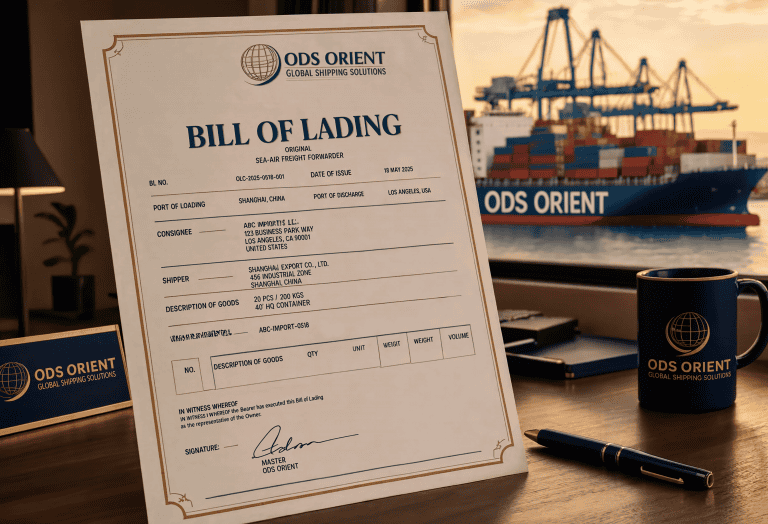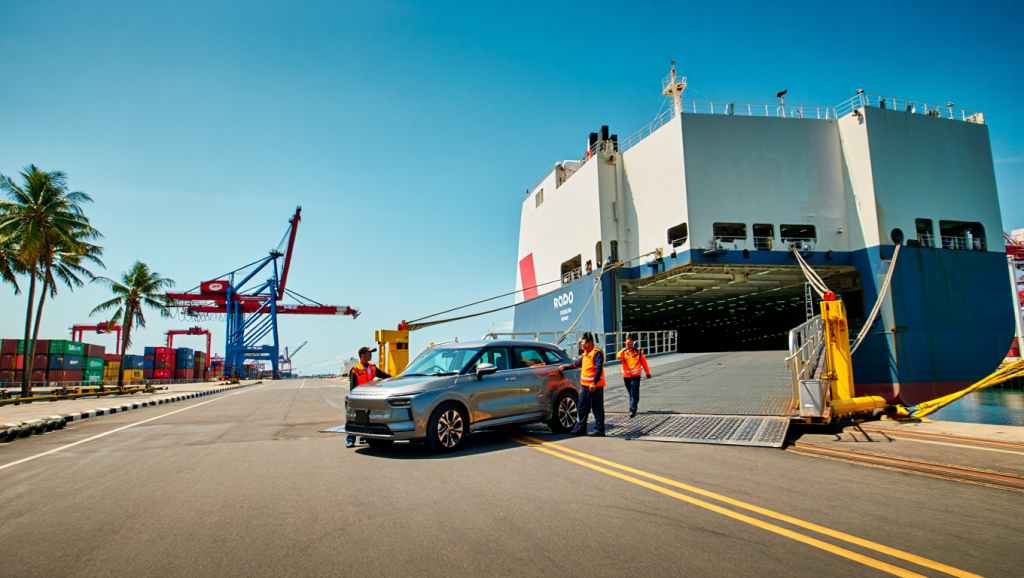
It is possible to ship a car to Indonesia by RoRo via the ports of Jakarta (Tanjung Priok) and Surabaya (Tanjung Perak). The transit time from Europe is around 28 to 35 days. Indonesia requires SNI certification, levies a luxury tax on certain vehicles and has strict import regulations. Careful preparation is therefore essential.
Short answer in 5 bullet points
- The main ports are Jakarta (Tanjung Priok) and Surabaya (Tanjung Perak).
- Transit time from European ports is approximately 28 to 35 days.
- SNI certification is mandatory for importing vehicles into Indonesia.
- Indonesia levies a luxury tax (PPnBM) on certain categories of vehicles.
- The import of second-hand cars is heavily restricted and regulated in Indonesia.
What shipping routes are available to Indonesia?
The main Ro-Ro routes to Indonesia run from European ports such as Bremerhaven, Hamburg, Antwerp and Zeebrugge, via the Suez Canal and the Indian Ocean, to the main Indonesian ports.
| Port of departure | Port of destination | Transit time (approx.) | Cover |
| Bremerhaven | Jakarta (Tanjung Priok) | 28–32 days | Singapore or Port Klang |
| Hamburg | Jakarta (Tanjung Priok) | 29–33 days | Singapore or Colombo |
| Bremerhaven | Surabaya (Tanjung Perak) | 30–35 days | Singapore |
| Antwerp | Jakarta (Tanjung Priok) | 27–31 days | Singapore or Port Klang |
Most routes involve a transhipment at a South-East Asian hub port such as Singapore. Direct routes are rare and are usually only available for large consignments of new vehicles.
What import regulations apply to vehicles in Indonesia?
Indonesia has very strict import regulations for vehicles. The import of second-hand cars is, in principle, only permitted under certain conditions and is heavily regulated. New vehicles are also subject to extensive certification and approval requirements.
- The import of second-hand cars is severely restricted for private individuals.
- Import licences are generally only available to registered importers.
- The Indonesian Ministry of Trade (Kemendag) must approve the import.
- Diplomatic vehicles and household effects are subject to special regulations.
- Right-hand-drive vehicles are not permitted in Indonesia – traffic drives on the left.
Please note: Indonesia is a left-hand-traffic country. Imported vehicles must comply with right-hand-drive standards or be converted. It is essential that you clarify this point before dispatch.
What is SNI certification and why do you need it?
SNI stands for Standar Nasional Indonesia – the Indonesian national standard. Every imported vehicle must have SNI certification, which confirms that it complies with Indonesian safety and environmental standards.
The SNI test covers, amongst other things, exhaust emissions, safety equipment, lighting and chassis number conformity. The process can take several weeks and must be carried out by an accredited testing body.
Submitting an application: At the Badan Standardisasi Nasional (BSN) or an accredited body.
Document verification: Vehicle technical data is checked against the SNI requirements.
Physical examination: The vehicle will be inspected and tested at the port of destination.
Issuing of certificates: If you pass, you will be awarded the SNI Certificate of Conformity.
Without a valid SNI certificate, the vehicle will not be cleared for import. You should therefore start the certification process as early as possible.
How much are the import duties and the luxury tax?
Import duties on vehicles into Indonesia consist of several components and are among the highest in South-East Asia.
- Import duty – depending on the vehicle category and engine capacity.
- Value Added Tax (VAT) – is calculated on the customs value plus import duty.
- Luxury tax (PPnBM) – Pajak Penjualan Barang Mewah, depending on the type of vehicle and engine capacity.
- Income tax prepayment (PPh) – a tax payable in advance on importation.
The PPnBM luxury tax can be substantial, depending on the vehicle category. Vehicles with large engine capacities and high CO₂ emissions, in particular, are heavily taxed in Indonesia. Since the reforms, Indonesia has been increasingly encouraging the import of low-emission vehicles.
Tip: Ask your clearing agent in Indonesia to provide you with a detailed breakdown of costs before dispatch. That way, you’ll know the total costs before making your final decision.
What are the distinctive features of the Indonesian market?
Indonesia is the largest car market in South-East Asia and has a number of specific features that you should bear in mind when importing a vehicle.
Driving on the left: Vehicles must be designed as right-hand-drive models – converting them is expensive and time-consuming.
Fuel quality: Fuel standards differ from those in Europe – check that your engine is compatible.
Spare parts section: For European vehicles, the availability of spare parts in Indonesia may be limited.
Tropical climate: High humidity and temperatures place particular demands on vehicle technology.
Infrastructure: On the islands off the coast of Java, road conditions can vary considerably.
Electric vehicles and hybrids are increasingly benefiting from tax breaks in Indonesia. The government is actively encouraging the switch to low-emission vehicles – which can have a positive impact on the overall cost of imports.
How does customs clearance work in Jakarta or Surabaya?
Customs clearance at Indonesian ports follows a structured process, which is usually managed by a local customs agent.
Arrival Notice: The shipping company will notify you when the vessel arrives at its destination port.
Submission of documents: The clearing agent submits all import documents to customs.
Determination of customs value: Customs checks the declared value of the vehicle and determines the CIF value.
Calculation of charges: Import duty, PPN, PPnBM and PPh are calculated.
Payment: All charges must be paid in full before authorisation is granted.
SNI test: The vehicle is inspected to ensure it complies with SNI standards.
Collection and handover: Once the inspection has been successfully completed and payment has been made, the vehicle will be released.
The whole process usually takes between seven and fourteen working days. If any documents are missing or if special checks are required, it may take considerably longer.
What tips can help you with shipping to Indonesia?
Shipping to Indonesia requires more preparation than many other destinations. These tips will help you make the process more efficient.
- Check your import authorisation before booking the shipment – not everyone is permitted to import vehicles into Indonesia.
- Please note the following regarding the steering: Only right-hand-drive vehicles are permitted for import.
- Start the SNI certification process well in advance – it can take several weeks.
- Gather all the documents together before dispatch and have them checked by the clearing agent.
- Calculate the total cost, including all taxes and charges, before making your final decision.
- Bear in mind the availability of spare parts for your vehicle model in Indonesia.
Good preparation will save you a lot of time and money in Indonesia. ODS Orient guides you through the entire process – from booking right through to customs clearance in Jakarta or Surabaya.
FAQ - Frequently asked questions
Can I import a second-hand car into Indonesia?
The import of second-hand cars into Indonesia is subject to severe restrictions for private individuals. As a rule, an import licence is required, which is only issued to registered importers. Special regulations apply to diplomatic staff and household effects.
How long does shipping from Germany to Jakarta take?
The transit time from German ports such as Bremerhaven or Hamburg to Jakarta is usually between 28 and 33 days. On top of this, there is the time required for customs clearance at the port of destination, which takes around seven to fourteen working days.
Do I need special insurance for Indonesia?
Transport insurance is strongly recommended. Check whether your policy also covers port-to-port transport and storage time at the port of destination. Country-specific risks should also be taken into account.
What happens if my vehicle fails the SNI test?
If the vehicle fails the SNI test, it must either be retrofitted or re-exported. The costs of retrofitting and retesting are borne by the importer. It is therefore essential to carry out a preliminary check of the technical requirements.
Are there any tax incentives for electric vehicles in Indonesia?
Yes, Indonesia is increasingly encouraging the import of low-emission vehicles. Reduced luxury tax rates apply to electric vehicles and certain hybrid models. The exact regulations change regularly – please check with your clearing agent for the latest information.
Conclusion
Shipping a car to Indonesia is possible, but it requires thorough preparation. From strict import regulations and SNI certification to luxury tax – there are many factors to bear in mind.
With the right partner by your side, the process becomes much easier. ODS Orient knows the routes, the regulations and the right local contacts. Contact us for a bespoke quote for your shipment to Indonesia.
Do you have any questions or would you like a non-binding offer? Contact us directly: https://odsorient.com/kontakt
All information in this article has been carefully researched but is subject to change at any time. ODS Orient accepts no liability for the topicality, accuracy and completeness of the information provided.