A comparison of RoRo and air freight shows that sea freight via RoRo is significantly cheaper, offers greater capacity and has a better environmental footprint. Air freight is only advantageous for small, high-value consignments with very short delivery times. For the transport of vehicles, construction machinery and heavy goods, RoRo is, in most cases, the more economical and sustainable solution. The decision depends on the goods being transported, the budget and the timeframe.
Short answer in 5 bullet points
- For vehicles, Ro-Ro sea freight costs only a fraction of the price of air freight.
- Air freight is only worthwhile for small, high-value spare parts that need to be delivered urgently.
- The carbon footprint of Ro-Ro transport is considerably lower than that of air freight.
- Vehicles and heavy machinery can only be shipped by Ro-Ro or container – not by air.
- The right choice depends on weight, volume, value and urgency.
What is the difference between Ro-Ro sea freight and air freight?
Anyone wishing to transport vehicles, machinery or other wheeled goods internationally is faced with the question: Ro-Ro sea freight or air freight? Both modes of transport have clear strengths and weaknesses, the relative importance of which varies depending on the situation.
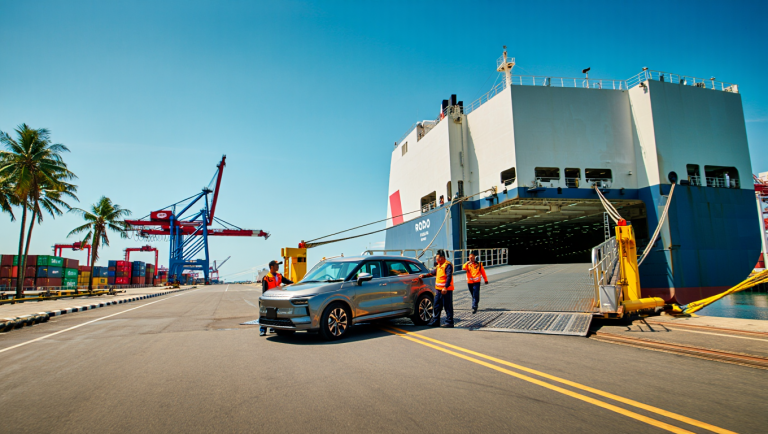
Ro-Ro ships are specially designed for roll-on/roll-off cargo. Vehicles are driven on board under their own power, which simplifies the loading process and saves costs. Air freight, on the other hand, is suitable for smaller, high-value consignments that need to reach their destination within a few days.
Below, we compare both options based on the key criteria – so that you can make an informed decision.
How do RoRo and air freight compare in a direct comparison?
The following table shows the key differences between the two modes of transport at a glance:
| Criterion | Ro-Ro sea freight | Air freight |
| Duration | 2–6 weeks, depending on the route | 1–5 days |
| Costs | Low to medium | High to very high |
| Capacity | Vehicles, machinery, heavy goods | Restricted to smaller goods |
| Vehicle transport | Ideal – on its own wheels | Not possible |
| carbon footprint | Significantly better | High CO₂ emissions per tonne |
| availability | Regular departures worldwide | Daily services |
| Insurance costs | Moderate | Higher due to the risk associated with the value of the goods |
As the table shows, RoRo is superior to other modes of transport for vehicles and heavy machinery in almost all categories – with the exception of speed.
When is air freight the better option?
Despite the advantages of RoRo, there are situations in which air freight is the best option:
- Urgent spare parts deliveries for machines or vehicles that are out of service
- High-quality electronics or lightweight specialist components
- Prototypes or samples that need to reach the recipient quickly
- Shipments weighing less than 100 kg, where the difference in cost is minimal
By contrast, air freight is not a viable option – either logistically or economically – for the transport of complete vehicles, construction machinery or agricultural equipment.
What are the differences in cost between Ro-Ro and air freight?
The difference in cost between the two modes of transport is considerable. Whilst a car can be shipped via Ro-Ro sea freight for a low four-figure sum, depending on the route, the cost of transporting just the weight of a vehicle by air freight would be many times higher.
For RoRo, charges are calculated on the basis of volume (CBM) or linear metres; for air freight, they are based on the actual or volumetric weight – whichever is higher. As a result, costs for bulky goods rise exponentially.
In addition, air freight often involves higher handling charges, fuel surcharges and security charges, which offset the cost advantage of the shorter transit time.
How does the environmental footprint differ?
Sustainability is playing an increasingly important role in international logistics. By comparison, Ro-Ro sea freight performs significantly better than air freight:
- Per tonne-kilometre, sea freight generates only a fraction of the CO₂ emissions produced by air freight.
- Modern Ro-Ro ships are increasingly using low-sulphur fuels and optimised routes.
- Air freight is by far the most emission-intensive mode of transport in global trade.
- Many companies now take their carbon footprint into account when choosing a mode of transport.
Anyone who ships vehicles or machinery and values a good environmental footprint will find RoRo to be the more sustainable alternative.
How do you make the right decision?
The choice between Ro-Ro and air freight depends on four key factors:
Cargo: Vehicles and machinery can only be shipped by Ro-Ro or in containers.
Urgency: For small parts where time is of the essence, air freight may be the best option.
Budget: RoRo offers the best value for money for high-volume goods.
Sustainability: Sea freight has a significantly lower carbon footprint.
In practice, it is clear that, for the vast majority of vehicle and machinery logistics, RoRo is the more economical, efficient and environmentally friendly solution.
What role does insurance play in the comparison?
One aspect that is often overlooked is transport insurance. With air freight, insurance costs are generally higher, as the declared value of the goods per consignment is often lower and the risk of damage increases due to frequent handling.
With Ro-Ro transport, you benefit from established safety protocols at ports and a comparatively low damage rate. Nevertheless, in both cases, it is advisable to take out specific transport insurance to cover the residual risk.
Seek advice in advance on the level of cover that is appropriate for your consignment – regardless of the chosen mode of transport.
FAQ - Frequently asked questions
Is RoRo always cheaper than air freight?
For vehicles and heavy goods, RoRo is significantly cheaper in almost all cases. Air freight can only be competitively priced for very small, light consignments – though this is rarely the case for vehicle-related shipments.
Can you send a car by air freight?
Technically, this would be possible in rare exceptional cases, such as when transporting exclusive luxury vehicles in specialised cargo aircraft. In practice, however, this is extremely expensive and completely uneconomical for regular shipments.
How long does a Ro-Ro shipment take compared to air freight?
Depending on the route, Ro-Ro shipments take between two and six weeks. Air freight usually reaches its destination within one to five days. For most vehicle shipments, however, the longer transit time with Ro-Ro is not a significant disadvantage.
Which goods are best suited to air freight?
Air freight is particularly suitable for small, light and high-value goods such as spare parts, electronic components or prototypes, where rapid delivery is crucial.
Is sea freight more environmentally friendly than air freight?
Yes, definitely. Sea freight generates only a small fraction of the CO₂ emissions of air freight per tonne-kilometre. Ro-Ro transport is one of the most efficient forms of international freight transport.
Can I combine Ro-Ro and air freight?
In certain cases, a combination makes sense – for example, urgent spare parts by air freight and the vehicle itself by RoRo. A specialist freight forwarder can plan the best solution here.
Conclusion
The comparison clearly shows that, for the transport of vehicles, construction machinery and bulky goods, Ro-Ro sea freight is the better choice in most cases – it is more cost-effective, more sustainable and offers sufficient capacity for any type of cargo.
Air freight is the best option for small, high-value and time-sensitive shipments. However, for the vast majority of logistics projects involving the shipment of vehicles and machinery, RoRo offers the superior overall package in terms of cost, reliability and environmental impact.
Do you have any questions or would you like a non-binding offer? Contact us directly: https://odsorient.com/kontakt
All information in this article has been carefully researched but is subject to change at any time. ODS Orient accepts no liability for the topicality, accuracy and completeness of the information provided.