Anyone who wants to take a touring vehicle across the ocean - whether a campervan, panel van, alcove or expedition vehicle - is faced with the fundamental question: container vs RORO for motorhomes? Both methods have clear strengths, but also limitations. In this guide, we compare safety, handling, dimensions/limitations, procedures in the harbour, documents, transit times and cost factors. There's also a concrete checklist, a pros/cons table and an FAQ with schema markup for maximum findability.
Summary: RORO (roll-on/roll-off) is often the first choice for larger, mobile motorhomes with roof extensions or superstructures. Containers score highly for compact vans and maximum load compartmentalisation - provided the door opening and interior dimensions are suitable. Your individual vehicle profile is what counts when making the final decision.
How to make the right decision
The decision between container vs RORO for motorhomes depends primarily on four parameters:
Vehicle dimensions (length/width/height) incl. attachments such as roof tent, solar panels, spare wheel carrier.
Rolling ability (ready to drive, steer and brake) and ground clearance (ramp inclination).
Safety and protection requirements (fully enclosed unit vs. vehicle deck).
Route availability & transit times (direct run, transhipment, port rotation).
Option 1: Motorhome via RORO (roll-on/roll-off)
Principle: The vehicle is driven directly on board via a ramp, positioned on the vehicle deck according to the stowage plan and secured by the crew in accordance with the Cargo Securing Manual (CSM). This reduces crane handling and speeds up the harbour process.
Advantages of RORO
Large tolerances for dimensions: Even high off-road motorhomes, alcoves and superstructures often fit without any problems.
Less handling risk: no need to use a crane for the vehicle itself.
Clear cut-offs & routines: Terminal processes are synchronised with vehicle flow.
Plannable handling: boarding/de-boarding by trained staff.
RORO challenges
The interior must be empty (no loose private items).
Tank level usually limited to ≤ 25 %; observe the battery specifications of the shipping company.
Deck environment: The vehicle is not in a "box", but secured on the deck/deck area.
Option 2: Motorhome in a container (e.g. 40' high cube)
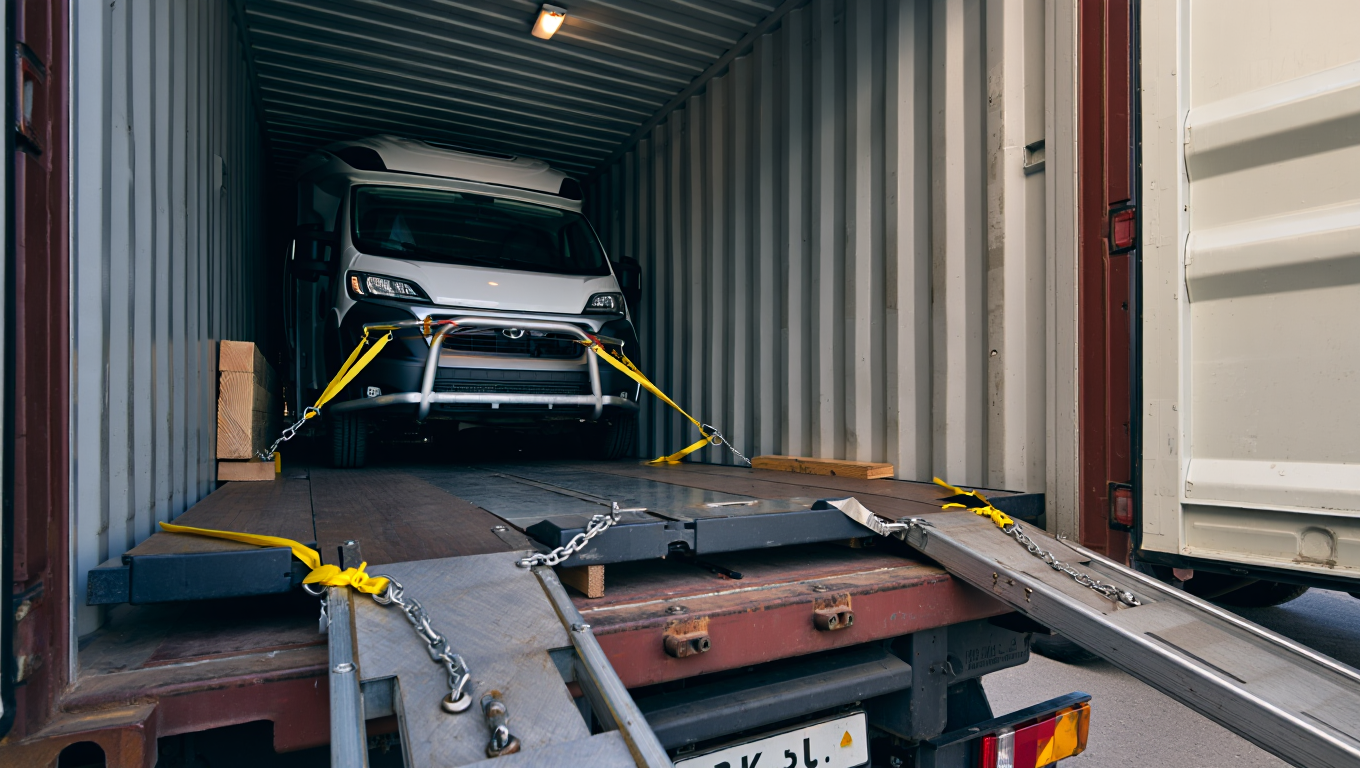
Principle: The vehicle is driven into a closed steel container or brought in using ramps/equipment and lashed down inside. The door opening and interior height are particularly important.
Typical reference value: Inside width approx. 2.35 m, height approx. 2.70 m, door opening approx. 2.34 m wide and approx. 2.58 m high. Please always check the actual specification.
Container advantages
Closed unit: Maximum insulation against environmental influences.
Additional protection against visual contact; seal/seal documents integrity.
Intermodal continuation by rail/truck easily possible.
Container challenges
Door opening as a bottleneck: Many campers fail due to door height/width or superstructures.
Lashing/securing effort in the container (wooden wedges, straps, blockings).
Handling/availability: special ramps, space required for packing, additional costs if necessary.
Fully equipped van: Container with suitable dimensions
Operational process in the harbour
RORO - Handover
Check-in at the gate
CCR protocol & handover photos
Assign parking space, hand in keys
Loading & securing according to CSM
Container packing process
Provide container
Lashing with straps & wooden wedges
Seal & enclose packing list
Gate-in to the terminal
Cost factors (without prices)
Dimensions & Method
Route & harbour rotation
Terminal handling
Customs & Documents
Insurance
Decision matrix
If you tick ≥ 3× "Yes" in a column, the procedure is usually set.
Question
RORO
Container
Height > 2.65 m or roof superstructures?
✅
Do you want maximum compartmentalisation?
✅
Door opening 40'HC realistic?
✅
Vehicle very wide/overbuilt?
✅
Packstation readily available?
✅
Want a fast harbour process?
✅
Disclaimer: All information in this article has been carefully researched but is subject to change at any time. ODS Orient accepts no liability for the topicality, accuracy and completeness of the information provided.
Do you have any questions or would you like to make use of our RoRo service?
Booking a RoRo shipment is easier than you think: you request a quote, submit your vehicle details, confirm the booking and prepare the documents. Then you deliver the vehicle to the terminal, where it is inspected and loaded onto the ship. The entire process from enquiry to loading typically takes 5-10 working days. Short answer [...]
In principle, all rollable vehicles and machines can be shipped by RoRo - from cars and off-road vehicles to lorries and semi-trailers to construction machinery, agricultural machinery and mobile homes. The decisive factor is that the load can be driven or towed independently. Non-roadworthy vehicles are also possible, provided they are steerable or can be loaded onto a MAFI trailer. [...]