Which vehicles can be shipped by RoRo? Cars, lorries, construction machinery & more
April 14, 2026
Reading time: 5 minutes
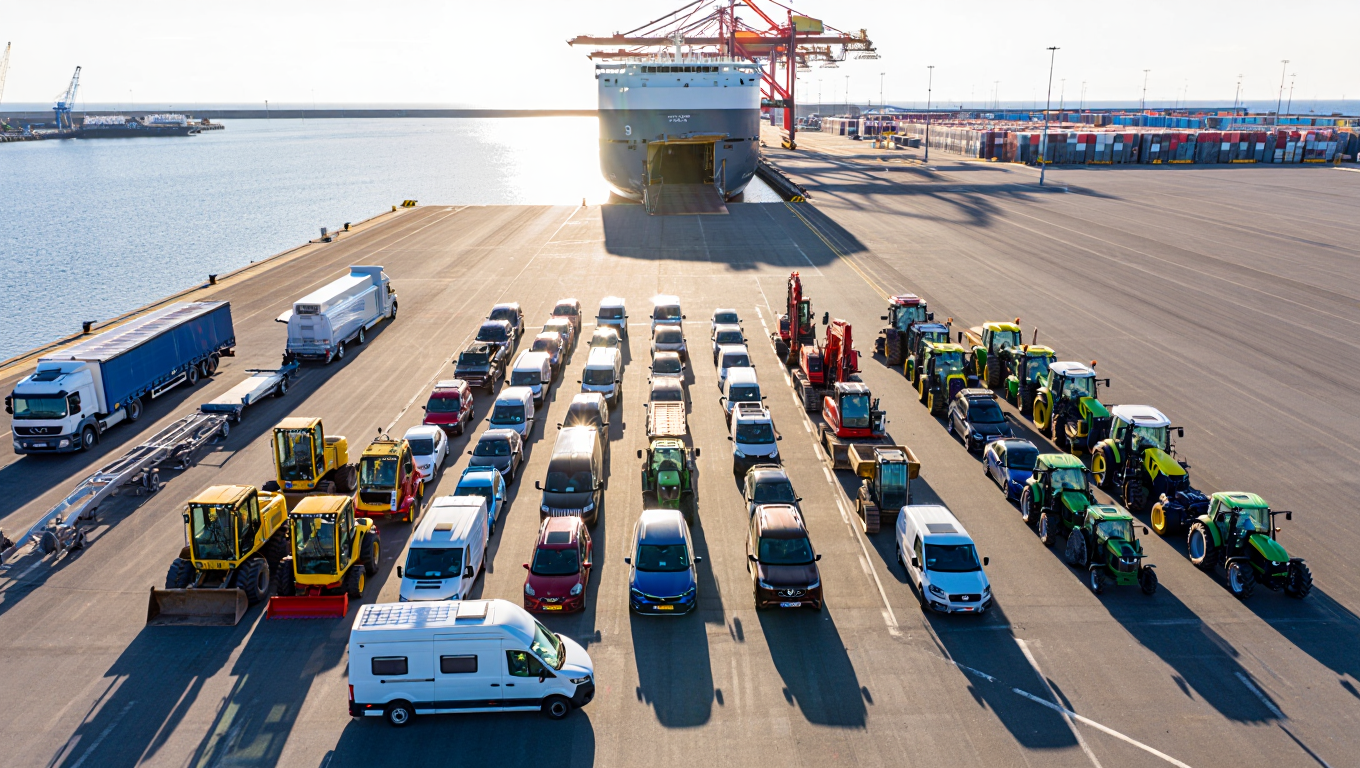
In principle, all rollable vehicles and machines can be shipped by RoRo - from cars and off-road vehicles to lorries and semi-trailers to construction machinery, agricultural machinery and mobile homes. The decisive factor is that the load can be driven or towed independently. Vehicles that are not roadworthy are also possible, as long as they can be steered or loaded onto a MAFI trailer.
Short answer in 5 bullet points
Cars, SUVs and off-road vehicles (new and used) are the most common RoRo cargo worldwide.
Trucks, transporters and tractor units are regularly shipped by RoRo to all target markets.
Construction machinery such as excavators, wheel loaders and cranes require special ramp and ground clearance tests.
Agricultural machinery (tractors, combine harvesters) and mobile homes are also typical RoRo goods.
Non-road vehicles can be loaded onto MAFI trailers - this is also possible via RoRo.
Which vehicle types are suitable for RoRo?
RoRo shipping is one of the most versatile transport methods for rollable goods. Basically, anything that can be driven onto a ship via a ramp - whether under its own power or by tugboat - is suitable for RoRo transport. The spectrum ranges from small cars to 80-tonne excavators.
In practice, a distinction is made between self-propelled cargo (vehicles that roll onto the ship independently) and towed cargo (vehicles that are moved by Tugmaster or on MAFI trailers). Both variants are standard for all major RoRo shipping companies.
Here is an overview of the most common vehicle categories:
Vehicle type
Typical examples
Special features
CAR & SUV
Saloons, off-road vehicles, sports cars
Most frequent RoRo cargo, easy handling
Trucks & vans
Tractor units, panel vans
Check height and weight
Construction machinery
Excavators, wheel loaders, rollers
Note ground clearance & ramp angle
Agricultural machinery
Tractors, combine harvesters, ploughs
Often overwidth - OOG check necessary
Motorhomes
Campers, motorhomes
Remove gas cylinders, check battery
Buses
Coaches, city buses
Observe the height restriction of the ship decks
Trailer
Semi-trailers, boat trailers
Must be towable
Project cargo
Generators, transformers
On MAFI trailer, lashing plan required
How are cars and used vehicles shipped by RoRo?
Cars are by far the most common cargo on RoRo ships. Every year, millions of new and used cars are transported worldwide on so-called PCTC (Pure Car and Truck Carrier) ships. These specialised ships have up to 13 vehicle decks and can carry several thousand vehicles at the same time.
For you as the shipper, the process is very simple: you deliver the vehicle to the terminal, it is inspected, photographed and then driven onto the ship via the rear ramp. On board, it is secured with brake wedges and lashing straps.
Important to know: The vehicle must be ready to drive - i.e. be able to start the engine, steer and brake. As a rule, personal items must not remain in the vehicle. The tank should be filled to a maximum of a quarter full.
What applies to construction machinery and heavy loads by RoRo?
Construction machinery such as excavators, wheel loaders, cranes and rollers are among the most demanding RoRo goods. Transport is possible in principle, but requires special attention during planning.
Decisive factors are the ground clearance, the ramp capability and the overall dimensions. Vehicles with a very low centre of gravity or wide tracks may have to be loaded onto MAFI trailers, which increases costs.
You can find a detailed guide to the requirements in our article RoRo for construction machinery 2026 (https://odsorient.com/roro-fuer-baumaschinen-2026-anforderungen-rampe-und-ground-clearance).
Ground clearance: At least 15-20 cm for the boat ramp
Weight: A survey and lashing plan is required for weights over 40 tonnes
Dimensions: Excess width (> 2.5 m) or excess height (> 4.0 m) must be registered in advance
Attachments: Buckets, buckets or booms must be secured or dismantled
Residual fuel: Depending on the shipping company, a maximum tank level of 10-25 % is permitted
Can agricultural machinery be shipped by RoRo?
Yes, agricultural machinery is another important cargo category in RoRo transport. Tractors, combine harvesters, forage harvesters and ploughs are regularly exported by RoRo to target markets in Africa, Asia and South America.
The challenge with agricultural machinery often lies in the extra widths. A modern combine harvester can quickly measure 3.5 metres or more in width - and thus exceed the standard dimensions. In such cases, this is referred to as OOG (Out of Gauge) loading, which requires special notification and planning.
You can find more information on this topic in our article Shipping agricultural machinery by RoRo (https://odsorient.com/landmaschinen-per-roro-verschiffen).
What about motorhomes and campers?
Motorhomes and campers can be shipped by RoRo, but require some preparation. Gas cylinders must be removed or properly secured. All loose items in the interior must be stowed or removed. The on-board battery should be disconnected.
Height also plays an important role for motorhomes: many RoRo ships have deck heights of 4.0 to 4.5 metres. Vehicles that exceed this height are transported on the top deck or the weather deck - which can incur additional costs.
The alternative to RoRo transport is the container. Which method is more suitable for your motorhome depends on the dimensions and the destination harbour.
What happens if a vehicle is not roadworthy?
Vehicles that are not roadworthy can also be shipped by RoRo - under certain conditions. The vehicle must at least be steerable so that it can be towed. In this case, a tugmaster (harbour tug) is used to tow the vehicle onto the ship.
If the vehicle is neither roadworthy nor steerable, it must be loaded onto a MAFI trailer. This is a flat special trailer that is often used in the RoRo terminal. This variant is more complex and more expensive, but is available as standard in many harbours.
In any case, you should discuss the condition of the vehicle with your haulier at an early stage so that the correct loading method can be planned.
What requirements must vehicles fulfil for RoRo shipping?
Regardless of the vehicle type, there are some basic requirements that apply to RoRo loading:
Ready to drive: Engine must start, vehicle must be steerable and brakeable (or towable)
Tank level: Maximum ¼ tank (safety regulation of the shipping companies)
No loose objects: The interior and loading area must be empty and secured
No leaks: Oil, fuel or coolant leaks lead to rejection at the terminal
Functioning parking brake: essential for securing loads on board
Clean underbody: Many destination countries (e.g. Australia, New Zealand) require biosecurity cleaning
Vehicles that do not fulfil these criteria will be turned away at the terminal. In the worst case scenario, you will miss your booked slot and have to wait for the next departure. Thorough preparation is therefore crucial.
FAQ - Frequently asked questions
Can motorbikes be shipped by RoRo?
Motorbikes alone cannot be booked as a single item with most RoRo shipping companies, as they cannot stand on their own and be secured. The alternative: transport in a wooden crate on a MAFI trailer or by container.
Can boats be shipped by RoRo?
Boats on a trailer can generally be shipped by RoRo, provided the trailer can be rolled. Boats without a trailer are usually transported by flat rack or as project cargo.
Is there a maximum weight for RoRo cargo?
There is no standardised upper limit. Most PCTC ships take cargo up to 100-120 tonnes. A survey is required in advance for very heavy cargo (from approx. 40 tonnes).
Can electric vehicles be shipped by RoRo?
Yes, electric vehicles can be transported by RoRo. However, special regulations apply to the state of charge of the battery, as lithium-ion batteries can be categorised as dangerous goods.
How much does it cost to ship a car RoRo?
The costs depend on the vehicle dimensions, weight and route. For a reliable calculation, we recommend a personalised quote at https://odsorient.com/kontakt.
Conclusion
RoRo shipping is remarkably versatile: from small cars and tractor units to 80-tonne excavators, almost anything that can roll can be transported. The right preparation and early coordination with an experienced freight forwarder are crucial.
Whether you want to ship a single vehicle or an entire fleet - with the right partner, the process becomes transparent and plannable. At ODS Orient, we can advise you on all vehicle types and find the optimum transport solution for your cargo.
Do you have any questions or would you like a non-binding offer? Contact us directly: https://odsorient.com/kontakt
All information in this article has been carefully researched but is subject to change at any time. ODS Orient accepts no liability for the topicality, accuracy and completeness of the information provided.
Do you have any questions or would you like to make use of our RoRo service?
In principle, all rollable vehicles and machines can be shipped by RoRo - from cars and off-road vehicles to lorries and semi-trailers to construction machinery, agricultural machinery and mobile homes. The decisive factor is that the load can be driven or towed independently. Non-roadworthy vehicles are also possible, provided they are steerable or can be loaded onto a MAFI trailer. [...]
RoRo stands for „roll-on/roll-off" and refers to a shipping method in which rollable cargo - i.e. vehicles, construction machinery or semi-trailers - is driven directly onto the ship via a ramp. In contrast to container transport, no crane or container is required. This makes RoRo fast, cost-effective and particularly gentle on the cargo. The method is suitable for [...]