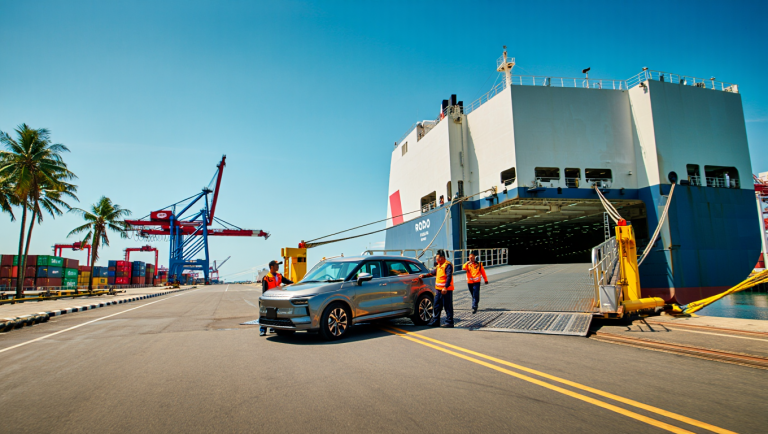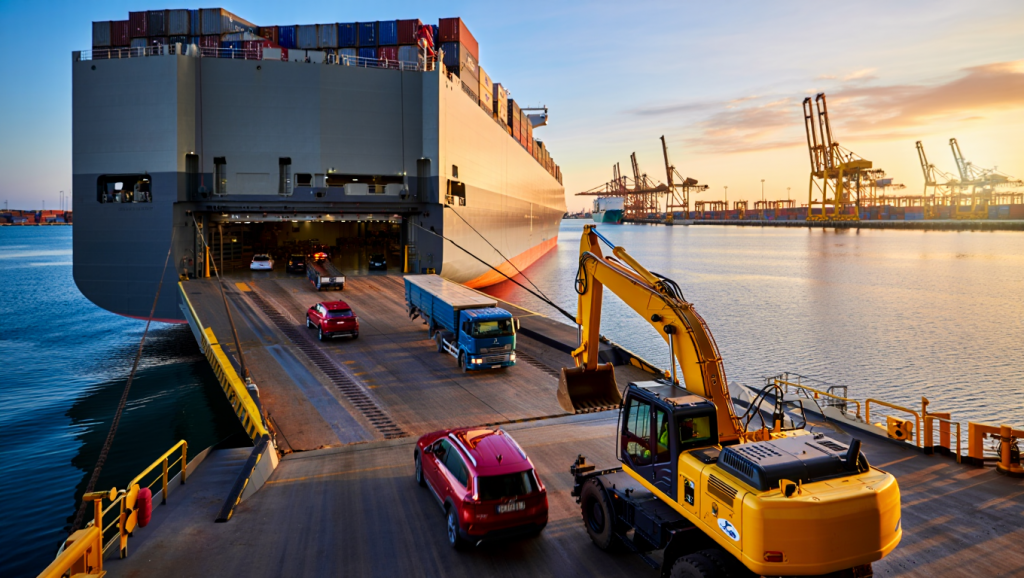
RoRo stands for „roll-on/roll-off" and refers to a shipping method in which rollable cargo - i.e. vehicles, construction machinery or semi-trailers - is driven directly onto the ship via a ramp. In contrast to container transport, no crane or container is required. This makes RoRo fast, cost-effective and particularly gentle on the cargo. The method is suitable for anyone who wants to ship vehicles or rollable goods internationally - from individual exports to fleet shipments.
Short answer in 5 bullet points
- RoRo means roll-on/roll-off: vehicles and machines roll onto the ship independently or by tugboat.
- No container required - the load travels directly on board via a rear ramp.
- Suitable for cars, lorries, construction machinery, agricultural machinery, motorhomes and semi-trailers.
- RoRo is generally cheaper and faster than container shipping with rollable cargo.
- Over 100 international routes connect Europe with Africa, Asia, America and the Middle East.
How exactly does RoRo shipping work?
The principle behind RoRo is very simple: your vehicle or machine is brought to the harbour, registered at the terminal and then driven onto the ship via a ramp. On board, the load is secured - either with lashing straps, brake wedges or special brackets on the vehicle deck.
At the port of destination, the process is reversed: the cargo rolls off the ship via the ramp and is handed over to the recipient. Depending on the route, there is a transit time of a few days to several weeks between loading and unloading.
For you as the shipper, this means less handling, fewer handling points and therefore a significantly lower risk of damage than with many alternative transport methods.
Which vehicles and goods can be shipped by RoRo?
In principle, RoRo is suitable for anything that can roll - either under its own power or with the help of a tug or MAFI trailer. This includes
- Cars and off-road vehicles (new and used)
- Trucks, vans and tractor units
- Construction machinery such as excavators, wheel loaders and cranes
- Agricultural machinery (tractors, combine harvesters)
- Motorhomes and campers
- Buses and special vehicles
- Trailers and semi-trailers
- Project loads on MAFI trailers (e.g. generators, transformers)
Even vehicles that are not roadworthy can be shipped by RoRo - provided they are steerable and can be towed. You can find out more about this in our article on the advantages and disadvantages of RoRo shipping (https://odsorient.com/roro-verschiffung-vorteile-und-nachteile).
What is the difference between RoRo and container shipping?
The two most common methods for international vehicle transport are RoRo and containers. Here are the most important differences at a glance:
| Criterion | RoRo | Container |
| Loading | Via ramp (rolling) | By crane into container |
| speed | Fast (less handling) | Slower (more steps) |
| Costs | Often cheaper with rollable cargo | More favourable for small parts/piece goods |
| Risk of damage | Low (little turnover) | Higher (crane, stowage) |
| Personal items | Generally not permitted | Possible (in container) |
| Flexibility | Rollable goods only | All types of goods |
You can find a detailed comparison of both methods in our article RoRo vs. container: When is which solution really worthwhile? (https://odsorient.com/roro-vs-container-wann-lohnt-sich-welche-loesung-wirklich).
How does a RoRo shipment work step by step?
The typical process of a RoRo shipment is divided into six steps:
1. obtain a quotation: You contact a specialised RoRo forwarder and provide the vehicle data: Dimensions (length, width, height), weight, pick-up location and port of destination.
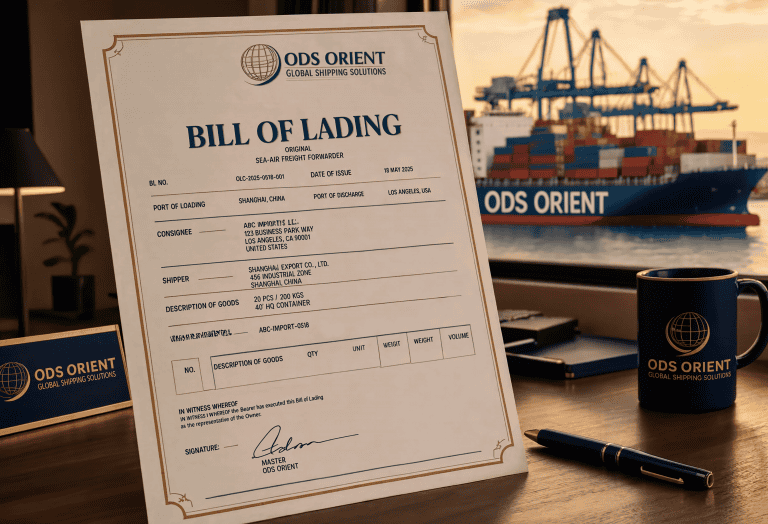
2. booking and documentation: Once the offer has been confirmed, the transport documents are prepared - including the commercial invoice, the Bill of Lading (B/L) and any export customs documents.
3. delivery to the harbour: The vehicle is taken to the agreed terminal. The gate-in takes place there: an incoming inspection with photo documentation.
4. loading: The vehicle drives or is driven onto the ship via the ramp and secured there.
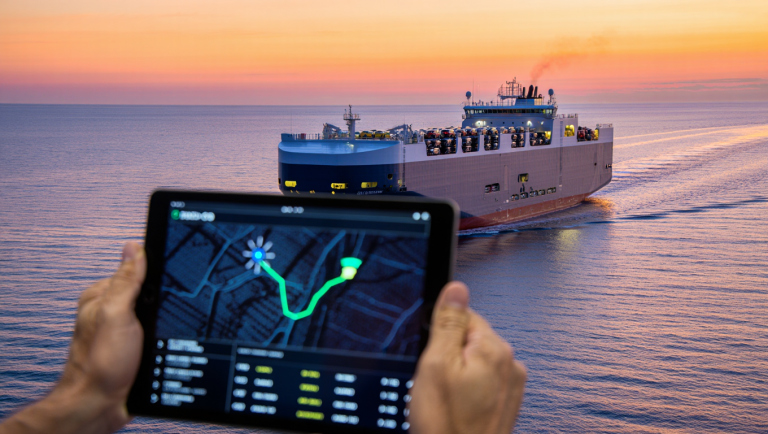
5. sea transport: During the crossing, you can usually track the status of your consignment online - via tracking using the VIN number or B/L number.
6. unloading and collection: The vehicle rolls off the ship at the port of destination. After customs clearance, it can be collected or transported onwards.
What does a RoRo shipment cost?
The costs for a RoRo shipment depend on several factors and cannot be quantified across the board. The most important cost drivers are
- Vehicle dimensions (length × width × height in metres) - billed by cubic metre (cbm)
- Weight - particularly relevant for heavy construction machinery
- Route and port of destination - transit time and availability influence the price
- Seasonal demand - freight rates rise during peak periods
- Additional services - e.g. pre-carriage to the port, insurance, customs clearance
For a reliable calculation, we recommend requesting a customised quote. This will give you a price that is tailored precisely to your load and route. Contact us directly at https://odsorient.com/kontakt.
Which routes are available by RoRo?
From European ports such as Bremerhaven, Hamburg, Antwerp or Southampton, you can reach almost any important destination worldwide by RoRo. The most common connections:
- Europe → Middle East (Jeddah, Dammam, Dubai, Sharjah)
- Europe → West Africa (Lagos, Tema, Dakar, Abidjan)
- Europe → East Africa (Mombasa, Dar es Salaam)
- Europe → South America (Santos, Buenos Aires, Cartagena)
- Europe → North America (New York, Houston, Halifax)
- Europe → Asia (Singapore, Bangkok, Yokohama, Shanghai)
- Europe → Oceania (Melbourne, Auckland)
Transit times vary depending on the destination. For example, it takes around 14-18 days from Bremerhaven to Jeddah, around 18-28 days to South America and 25-40 days to Asia.
Who is RoRo shipping particularly suitable for?
RoRo is not only interesting for large companies. The method is suitable for a wide range of shippers:
- Car dealers and exporters who regularly sell vehicles abroad
- Construction companies that supply machinery to international construction sites
- Agricultural businesses that export tractors or harvesting machinery
- Private individuals who take their vehicle with them when moving abroad
- Freight forwarders and logistics service providers that offer their customers vehicle transport services
- OEMs and fleet managers who organise series deliveries
What should you look out for when choosing a RoRo freight forwarder?
Not every freight forwarder specialises in RoRo. To ensure that your shipment runs smoothly, you should pay attention to the following points:
- Experience with RoRo transports and the respective target market
- Transparent communication on costs, processes and documents
- Own tracking system or status updates during transport
- Support with customs documentation and export formalities
- Personal contacts instead of automated processes
FAQ - Frequently asked questions about RoRo shipping
What does RoRo mean?
RoRo is the abbreviation for „roll-on/roll-off". It describes a loading principle in which vehicles and rollable goods travel onto the ship via a ramp - without a crane or container.
Is RoRo cheaper than containers?
For rollable cargo, RoRo is the more favourable option in most cases, as less handling and no container is required. For small parts or non-rollable cargo, however, the container can be more economical.
Can I leave personal items in the vehicle?
As a rule, no. Most shipping companies and customs authorities do not allow personal items in the vehicle during RoRo shipping. Everything inside the vehicle must be removed beforehand.
How long does a RoRo shipment take?
The pure transit time is between 7 and 40 days, depending on the route. In addition, there are lead times for documentation, gate-in and customs clearance at the port of destination. You should expect a total of 3-8 weeks.
Do I need transport insurance for RoRo?
Transport insurance is not required by law, but is strongly recommended. The shipping company's liability is usually limited to a fraction of the value of the vehicle. All-risk insurance protects you comprehensively against damage during the entire transport.
Can I ship an unroadworthy vehicle by RoRo?
Yes, this is possible - as long as the vehicle is steerable and can be towed. Vehicles that cannot be steered must be loaded onto a MAFI trailer, which incurs additional costs.
Which ports offer RoRo service in Germany?
The most important German RoRo ports are Bremerhaven (Europe's largest automobile port), Hamburg and Emden. From there, there are regular connections to all important target markets worldwide.
Conclusion
RoRo shipping is the most efficient and often most cost-effective method of transporting vehicles, construction machinery and other goods on wheels internationally. The principle is simple, the process standardised and the global route coverage excellent.
Whether you want to ship a single vehicle or an entire fleet - with the right partner at your side, the process becomes transparent and plannable. At ODS Orient, we support you from the initial enquiry through to collection at the port of destination.
Do you have any questions or would you like a non-binding offer? Contact us directly: https://odsorient.com/kontakt
All information in this article has been carefully researched but is subject to change at any time. ODS Orient accepts no liability for the topicality, accuracy and completeness of the information provided.