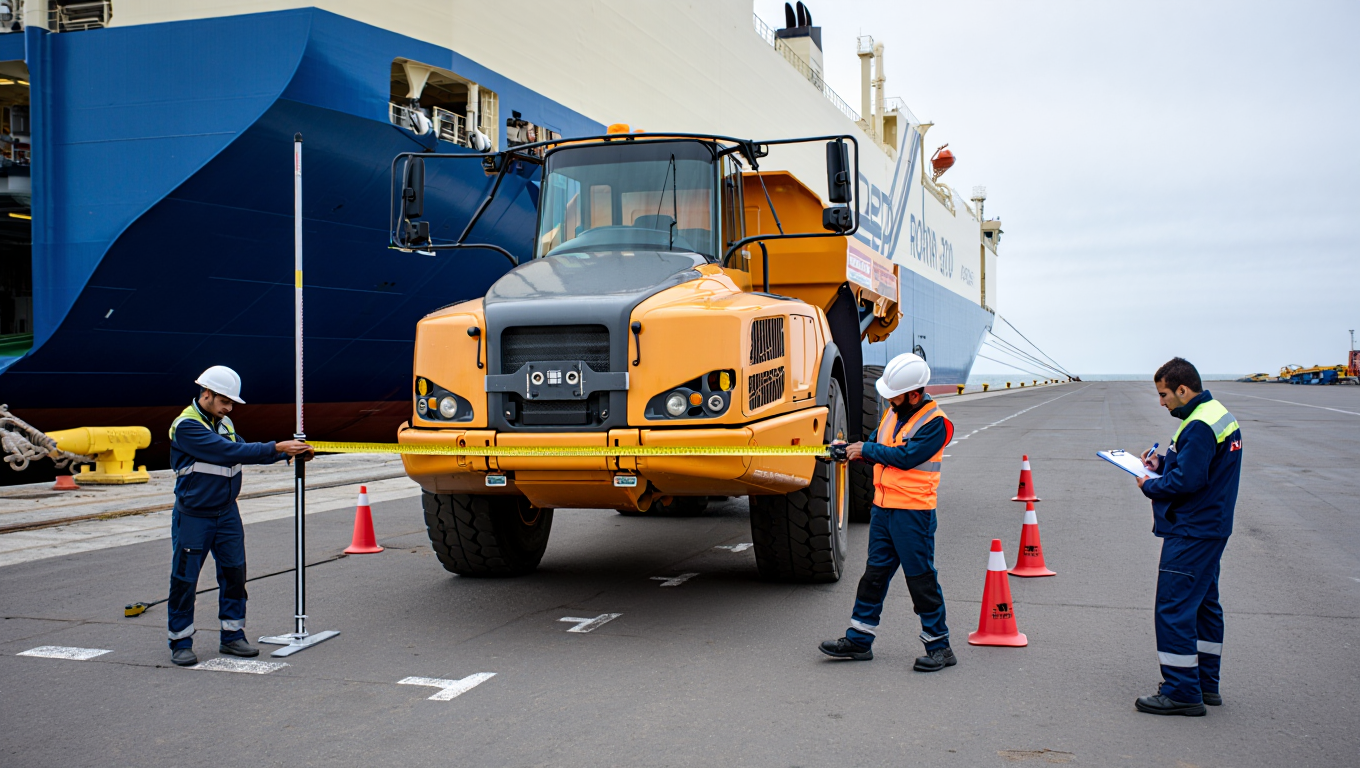
The RoRo cbm calculation determines the volume of a vehicle based on length, width and height in metres. This volume is the central basis for planning capacity and invoicing in RoRo transport. Errors in the calculation often lead to delays or additional costs. Those who measure correctly and take all attachments into account can plan transports efficiently and avoid risks.
Short answer in 5 bullet points
- roro cbm calculation based on length width height in metres
- Volume determines space requirements on the ship
- Precise dimensions prevent additional costs and delays
- Attachments must also be taken into account
- Basis for planning, booking and documentation
Introduction
In international vehicle transport, precise planning is crucial for a smooth process. Especially in RoRo transport, the volume of a vehicle plays a central role. The so-called roro cbm calculation is far more than just a mathematical formula. It influences the entire transport chain, from booking and loading through to invoicing.
In practice, it is often the case that inaccurate volume information can lead to considerable problems. These include incorrectly planned loading areas, inefficient utilisation of capacities or unexpected additional costs. Understanding and correctly applying the roro cbm calculation creates a solid basis for safe and efficient transport.
What does roro cbm calculation mean
Definition of cbm in the RoRo context
CBM stands for cubic metre and describes the volume of a vehicle or a load. In RoRo transport, this volume is used to:
- determine the required space on a ship
- optimise load planning
- create the basis for transport costs
The roro cbm calculation is always based on a fixed scheme that is used worldwide.
Why cbm is so important in RoRo
RoRo ships such as PCTC are designed to transport vehicles efficiently on several decks. However, the available space is limited and must be optimally utilised.
A correctly calculated volume makes this possible:
- Better planning of deck utilisation
- More efficient utilisation of MAFI trailers
- More precise coordination between POL and POD
How the RoRo volume is calculated
The basic formula
The roro cbm calculation is based on a simple formula:
Length in metres multiplied by width in metres multiplied by height in metres
The result is the volume in cubic metres.
Example from practice
A vehicle with the following dimensions:
- Length 6 metres
- Width 2 5 metres
- Height 3 metres
Results in a volume of:
6 times 2 5 times 3 equals 45 cubic metres
In practice, it is often the case that errors occur here, especially when dimensions are rounded or incomplete.
What must also be taken into account
In addition to the basic dimensions, the following factors must also be taken into account:
- Mirrors and side attachments
- Antennas or superstructures
- Load on the vehicle
- Non-folding components
What role do ship types and equipment play
PCTC ships
PCTC ships are specially designed for vehicles. They are equipped with:
- Several decks with different heights
- Flexible ramp systems
- Special safety devices
The roro cbm calculation helps to determine on which deck a vehicle can be loaded.
MAFI Trailer
MAFI trailers are often used for larger or heavier vehicles. These enable
- Better weight distribution
- More flexible positioning
- Transport of non-roadworthy units
Here too, the volume is decisive for planning.
How does the roro cbm calculation work in the booking process?
Step 1 Data collection
All vehicle data is recorded at the beginning:
- Length Width Height
- Weight
- Special properties
Step 2 Calculation and testing
The roro cbm calculation and a plausibility check are then carried out.
Step 3 Coordination with the shipping company
The calculated values are transmitted to the shipping company. They check them:
- Availability of capacities
- Suitable decks
- Possible restrictions
Step 4 Documentation
All data is recorded in the B L and in other documents.
This guide is recommended for optimal preparation:
https://odsorient.com/digitaler-roro-buchungsprozess-so-bereitest-du-deine-verschiffung-optimal-vor-2
Which errors occur frequently
Typical errors in volume calculation
In practice, the following errors often occur:
- Dimensions are estimated instead of measured
- Attachment parts are forgotten
- Dimensions are converted incorrectly
- Height is underestimated
Effects of these errors
Errors in the roro cbm calculation can lead to:
- incorrect load planning
- Delays in the harbour
- additional handling costs
- Refusal of loading
lead.
Table Example for roro cbm calculation
Vehicle type Standard car
Length 4 5 metres
Width 1 8 metres
Height 1 5 metres
Volume 12 15 cbm
Vehicle type Construction machine
Length 8 metres
Width 3 metres
Height 3 5 metres
Volume 84 cbm
Description This table shows typical differences in the volume of different vehicles and emphasises the importance of exact measurements for planning
How can you optimise the calculation
Precise measurement methods
Always use:
- Professional measuring devices
- Current vehicle data
- Visual documentation
Standardised processes
A structured process helps to avoid mistakes:
- Use checklist
- Double check data
- Document communication
Use digital tools
Digital systems improve accuracy and efficiency. Similar to performance optimisation in the web sector, the importance of structured processes is also evident here:
https://web.dev/blog/inp-cwv-march-12
Checklist for the roro cbm calculation
Preparation
- Fully inspect the vehicle
- Record all dimensions
- Create photos
Calculation
- Convert dimensions to metres
- Calculate volume
- Check results
Validation
- Coordinate data with freight forwarder
- Involve shipping company
- Complete the documentation
Realisation
- Prepare vehicle
- Follow the loading instructions
- Monitor loading
Which documents are relevant
The roro cbm calculation and transport are required:
- Bill of Lading
- Technical data sheets
- Photos
- Transport instructions
These documents ensure transparency and security throughout the entire process.
FAQ Frequently asked questions
What is cbm in RoRo transport
CBM describes the volume of a vehicle in cubic metres and is the basis for planning and invoicing.
Why is the roro cbm calculation so important
It determines how much space a vehicle requires on the ship and thus influences costs and planning.
What happens in the event of incorrect information
Incorrect information can lead to delays, additional costs or even rejection of the shipment.
Is the weight also taken into account
Yes, in addition to volume, weight also plays an important role, especially when using MAFI trailers.
How do I get an accurate calculation
As each transport is individual, we recommend a personal enquiry:
https://odsorient.com/kontakt
Conclusion
The roro cbm calculation is a central component in RoRo transport and influences almost all processes along the supply chain. From planning and booking to loading, the volume forms the basis for efficient decisions.
Those who measure precisely, use structured processes and avoid typical errors can not only control costs but also minimise risks. Especially in an international context with complex processes between POL and POD, a clean database is crucial for success.
Disclaimer All information in this article has been carefully researched but is subject to change at any time ODS Orient accepts no liability for the currency, accuracy or completeness of the information provided