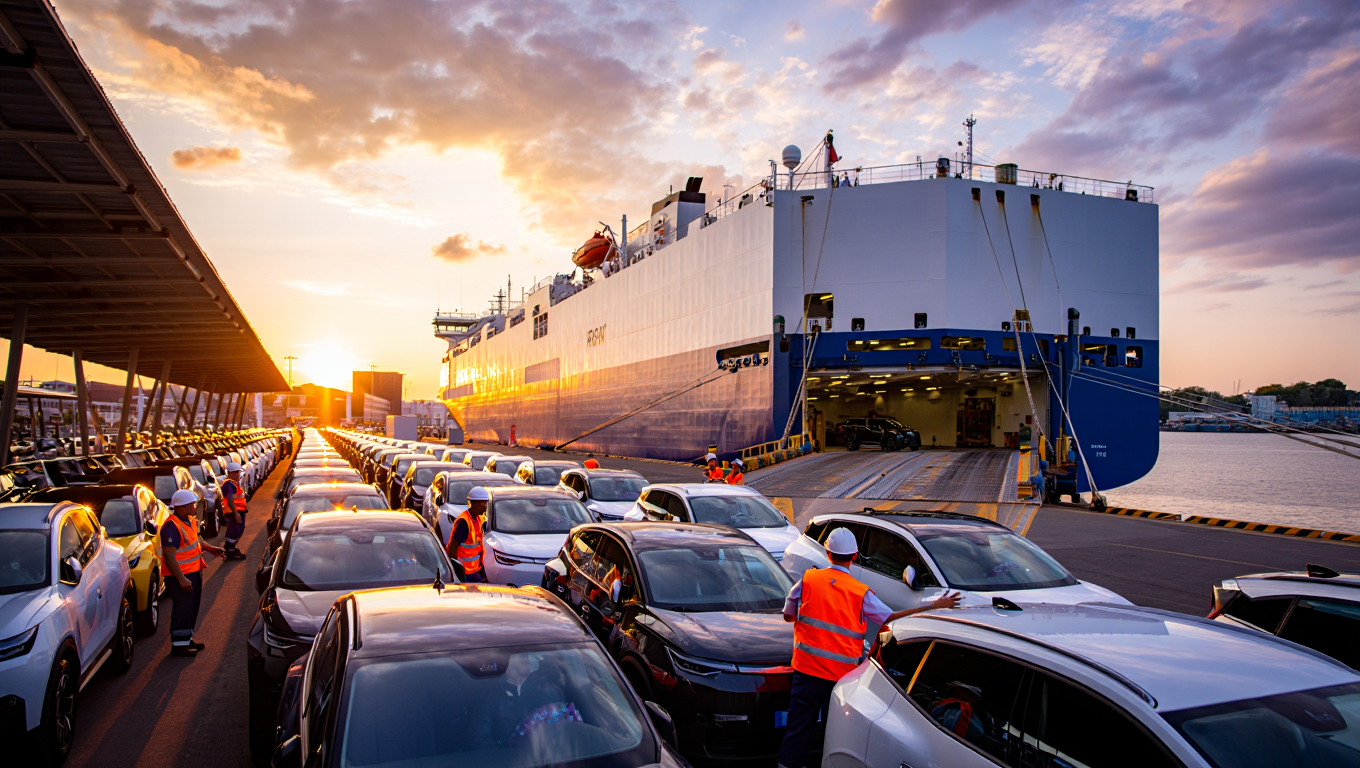
The transport of an electric car by RoRo ship follows clear international safety rules. The state of charge of the battery, possible dangerous goods classifications and correct documentation in the Bill of Lading are particularly important. In practice, shipping companies usually require a reduced state of charge of the battery, complete vehicle data and tested safety standards during loading. Anyone shipping a roro electric car should therefore be familiar with transport regulations, documents and port processes in order to avoid delays or safety risks.
Short answer in five central points
International safety regulations for lithium-ion batteries apply to roro electric car transport.
The battery usually has to be brought to a reduced state of charge before shipping.
Shipping companies require complete documentation including vehicle data and bill of lading.
RoRo ships are specially designed for rolling vehicles and enable fast loading and unloading.
Early coordination with the forwarder and shipping company prevents delays or safety problems.
Introduction Why RoRo transport is specially regulated for electric vehicles
The global trade in electric vehicles is growing rapidly. Car manufacturers, dealers and private customers are increasingly having vehicles transported via international sea routes. One of the most efficient methods is RoRo transport.
RoRo stands for Roll on Roll off and describes ships on which vehicles are driven directly onto the deck via ramps. This method is used worldwide for cars, lorries, construction machinery and special vehicles.
However, the strong growth in electromobility is creating new requirements for maritime transport. The high-voltage batteries of modern electric cars are considered a potential risk, particularly with regard to thermal events or damage during transport.
That is why the shipping of a roro elektroauto is subject to special international safety guidelines, technical specifications of the shipping companies and clear documentation requirements.
In this article, we explain in practical terms which rules apply, how the process works and what shippers should pay particular attention to.
How RoRo transport works for electric vehicles
RoRo ships are among the most efficient means of transport in the global vehicle trade. Large car carriers, also known as PCTCs, can transport several thousand vehicles at the same time.
PCTC stands for Pure Car and Truck Carrier and describes specially designed car transporters with several vehicle decks.
The process of a roro elektroauto transport typically follows several steps.
Vehicle delivery to the harbour
The vehicle is first brought to the harbour. A technical visual inspection and registration in the harbour system are carried out there.
In practice, the following is checked
Vehicle identification number
external condition
Battery status
Documentation of the vehicle
This test is important because RoRo vehicles must be capable of travelling independently.
Loading via the ship's ramps
In the RoRo process, a trained harbour employee drives the vehicle directly into the ship via a ramp. There it is parked and secured on a vehicle deck.
The vehicles are parked close together, which is why clear safety regulations apply.
With a roro electric car in particular, the system checks whether the vehicle is ready for operation and does not display any warning messages.
Transport on the car transporter
During the sea voyage, the vehicles remain secured on the decks of the car transporter. Modern RoRo ships are equipped with
Ventilation systems
Fire monitoring
Video surveillance
Special safety protocols for electric vehicles
Unloading at the port of destination
At the port of destination, unloading also takes place via ramps. Vehicles are then transferred to logistics areas or forwarded directly to freight forwarders.
The scheduled departure and arrival times are usually referred to as ETD and ETA.
Current routes and departure times can be viewed on the timetables page, for example
https://odsorient.com/fahrplaene
What regulations apply to electric car batteries in maritime transport
Lithium ion batteries are generally considered dangerous goods in international transport.
However, electric vehicles are often transported as complete vehicles, which means that different regulations apply than for individual batteries.
The international CTU Code of the International Maritime Organisation forms an important basis.
IMO CTU Code
https://www.imo.org/en/OurWork/Safety/Pages/CTU-Code.aspx
This guide describes safe packaging and transport methods for cargo units in international transport.
State of charge of the battery
Many shipping companies require a reduced battery charge level for a roro electric car.
In practice, this is often between twenty and fifty per cent.
A low state of charge reduces possible risks in the event of a battery defect.
It also makes handling in the harbour easier, as vehicles can still be driven.
Technical condition of the vehicle
An electric vehicle must be roadworthy. Vehicles with technical error messages or damaged batteries are generally not loaded.
Frequent checks are carried out in practice
No visible damage to battery housings
No warning messages in the vehicle display
No greatly increased state of charge
Safety distances on the ship
Some shipping companies use special parking rules for electric vehicles.
These can include
Certain deck areas for electric vehicles
Greater distances between vehicle groups
Additional fire monitoring
What documents are required for RoRo shipping
International vehicle transport requires several transport documents.
These documents are important for both the shipping company and the customs authorities.
Bill of Lading
The most important transport document is the Bill of Lading or B L.
It confirms
the receipt of the goods
the transport agreement
the proof of ownership during transport
For a roro electric car, the document typically contains
Vehicle identification number
Vehicle type
Port of loading POL
Port of discharge POD
Planned departure and arrival time
Vehicle documents
The following may also be required
Vehicle registration document or proof of export
Customs documents
Shipping order
Dangerous goods declaration if required
You can also find a detailed overview of the vehicle shipping process here
What do I need to consider for a RoRo shipment?
https://odsorient.com/was-muss-ich-bei-einer-roro-verschiffung-beachten
Typical risks when transporting electric vehicles
Transporting a roro electric car is generally considered safe. Nevertheless, there are some typical risk factors.
Damaged batteries
Damage to the vehicle can lead to problems during transport. Structural damage in the area of the battery pack is particularly critical.
In such cases, a shipping company may refuse loading.
State of charge too high
A common problem in practice is that the battery level is too high when the vehicle is delivered.
A fully charged electric car can be rejected by the shipping company.
Missing documentation
Incomplete vehicle data can cause delays at the port.
Correct VIN data and complete transport documents are particularly important.
Delays in the harbour
If vehicles arrive late at the harbour or fail safety checks, the transport may be postponed to the next departure.
Practical check Preparing an electric car for RoRo shipping
In practice, it often turns out that good preparation significantly simplifies the entire transport process.
Preparation of the vehicle
The state of charge of the battery should be reduced in good time.
The vehicle should be ready to drive and have sufficient range for short manoeuvring trips.
All personal belongings must be removed from the vehicle.
Technical control
A brief technical inspection is recommended before delivery.
Particularly important are
No warning messages in the vehicle
No visible damage
Functioning brakes and steering
Document preparation
All transport documents should be fully prepared before delivery to the port.
These include
Bill of Lading data
Vehicle identification number
Export documents
Customs information
Importance of RoRo transport in the global vehicle trade
RoRo ships play a central role in the international automobile trade.
The increasing demand for electric vehicles means that more and more roro elektroauto transports are taking place worldwide.
Global trade analyses also confirm the increasing importance of maritime vehicle transport.
UNCTAD Review of Maritime Transport
https://unctad.org/system/files/official-document/rmt2025overview_en.pdf
The report shows that vehicle transport via specialised car transporters remains an important part of global supply chains.
Transport volumes continue to grow, particularly between Europe, Asia and North America.
FAQ Frequently asked questions about the RoRo transport of electric cars
Is an electric car dangerous goods during RoRo transport?
Unlike individual batteries, a complete electric vehicle is not usually transported as classic hazardous goods. Nevertheless, special safety rules apply to lithium batteries and their state of charge.
How full may the battery be when shipping
Many shipping companies require a reduced battery charge level. This is often between twenty and fifty per cent.
Must an electric car be roadworthy
Yes, vehicles must be able to be driven onto the ship independently. Vehicles that are not ready to drive are usually unsuitable for RoRo transport.
Which ports are typical for RoRo transport
Large RoRo terminals are located in European seaports, for example, as well as in important vehicle export regions around the world.
How high are the costs for transport
The costs depend on the route, vehicle type, harbour and current market conditions. An individual offer is usually required for an exact calculation.
Conclusion
Shipping an electric vehicle by RoRo ship is an established and efficient method of transport in the international vehicle trade.
At the same time, transporting a roro electric car entails special requirements. These include a reduced state of charge of the battery, complete transport documents and compliance with international safety guidelines.
If you take these points into account at an early stage, you can make the transport process much smoother.
Close coordination between the shipper, freight forwarder and shipping company helps to avoid typical problems in the port and ensure safe vehicle transport via international sea routes.
Disclaimer: All information in this article has been carefully researched but is subject to change at any time. ODS Orient accepts no liability for the topicality, accuracy and completeness of the information provided.