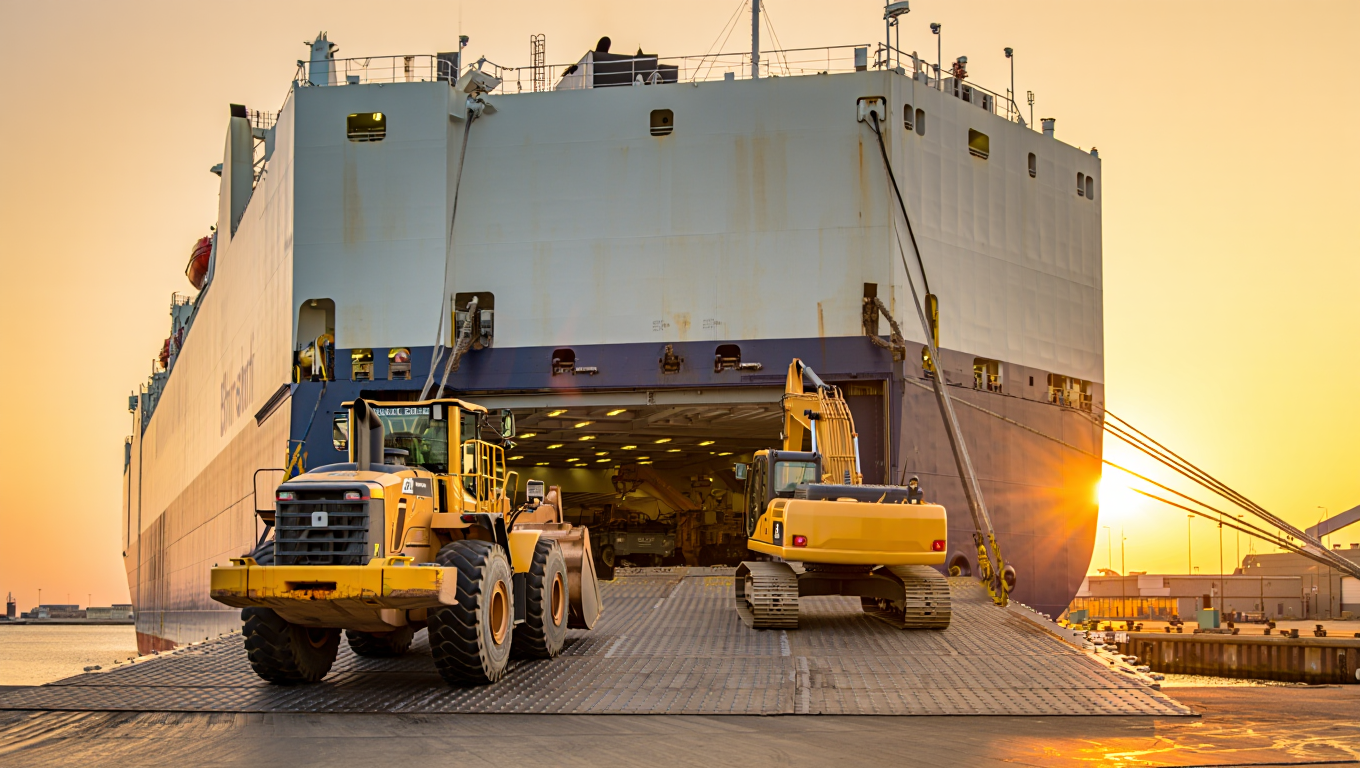
RoRo construction machinery transport is one of the most efficient methods of shipping construction machinery internationally. Vehicles are driven directly onto a RoRo ship via a ramp. Technical factors such as ramp angle, ground clearance and machine dimensions are decisive. In addition, documents such as B L, ETD ETA information as well as POL and POD must be prepared correctly. In practice, careful technical preparation determines whether construction machinery can be loaded without any problems or whether delays occur in the harbour.
Short answer in 5 bullet points
- RoRo construction machinery is driven directly onto the ship via a ramp and does not require container loading.
- Ramp angle, ground clearance and machine weight are decisive for loading.
- Frequently used means of transport are RoRo ships, PCTC carriers or MAFI trailers.
- Documents such as B L and transport data such as ETD ETA, POL and POD are mandatory.
- A technical pre-check of the aircraft prevents typical problems during boarding.
Introduction
International construction projects often require fast and reliable transport of heavy machinery. Transport by RoRo ship has proven to be particularly efficient for excavators, wheel loaders and road construction machinery.
The term RoRo stands for Roll on Roll off. Vehicles and machines are driven onto the ship via a ramp and driven off again at the port of destination. This method significantly reduces handling times and is therefore the preferred transport solution for many construction companies and project logisticians.
In 2026 in particular, several technical factors play an important role in roro baumaschinen transports. These include ramp angles, ground clearance of the machines and the maximum load capacity of the loading areas. In addition, precise transport documents are required to ensure that international transport runs smoothly.
This guide explains the most important requirements that should be taken into account when shipping construction machinery by RoRo.
How does the transport of RoRo construction machinery work?
In RoRo transport, the machine is driven onto the ship independently or with the support of terminal vehicles. This process is known as boarding.
Loading takes place in several steps.
First, the machine arrives in the harbour at the terminal. A technical inspection of the dimensions and ground clearance is carried out there. A decision is then made as to whether the machine can travel directly over the ramp or whether a MAFI trailer is required.
A MAFI trailer is a special heavy-duty platform used in harbour operations. Construction machinery is placed on it and then pulled onto the ship by terminal tractors.
After boarding, the aircraft is secured in the ship with special lashings. These lashings prevent movement during the voyage.
At the port of destination, the process is reversed. The machine is released, unloaded via the ramp and then handed over to the recipient.
What technical requirements apply to RoRo construction machinery
The most important point with roro baumaschinen transports is the technical feasibility of the loading.
The following factors are decisive.
Machine height
RoRo ships have limited deck heights. Large construction machinery must therefore often be loaded on open decks or special decks.
Machine width
If a machine exceeds the standard width, the load may have to be positioned on special loading areas.
Machine weight
The load-bearing capacity of the ramps and decks must be taken into account. Modern RoRo ships can carry several hundred tonnes per deck, but there are still technical limits.
Ground clearance
The ground clearance determines whether a machine can safely negotiate the ramp angle.
Why the ramp angle is so important
One of the most common challenges in RoRo transport is the transition between the harbour ramp and the ship.
This transition creates an angle. If the machine has too little ground clearance, it can touch down.
In practice, the following problem often arises.
Large road pavers or low-loaders have very low ground clearance. When driving onto the ship, the centre section of the machine can rest on the ramp. This creates a risk of damage.
Terminal operators therefore check the so-called breakover angle before each loading.
If the risk is too high, an alternative loading method is selected.
Ground clearance for construction machinery
Ground clearance describes the distance between the lowest point of the machine and the ground.
This value is particularly important for roro construction machinery. Machines with high ground clearance, such as wheel loaders or dumpers, can usually be loaded without any problems.
Machines with low ground clearance, on the other hand, require additional planning.
Typical examples with low ground clearance are.
Road paver
Rollers with long chassis
Special tunnelling machines
In such cases, a MAFI trailer can be used to avoid the critical ramp angle.
Typical RoRo means of transport for construction machinery
Several types of ship are used for roro construction machinery.
RoRo Carrier
These ships are specially designed for vehicles and have several internal decks.
PCTC Carrier
PCTC stands for Pure Car and Truck Carrier. These ships normally transport cars, but can also accommodate construction machinery.
Heavy lift RoRo vessels
Some specialised ships have reinforced decks and larger ramps.
The choice of ship type depends on the weight, size and destination harbour of the machine.
Documents for RoRo transport
International transport requires several documents.
Bill of Lading
The B L is the central transport document and confirms the sea transport.
Transport data
ETD describes the planned departure date of the ship. ETA describes the expected arrival.
Harbour details
POL stands for Port of Loading and describes the port of departure. POD describes the port of destination.
In addition, customs information and export documents must be prepared.
Safety requirements for loading construction machinery
International safety guidelines apply to the transport of roro construction machinery.
An important reference is the CTU Code of the International Maritime Organisation. This guideline describes safe methods for securing cargo in international transport.
Further information is available here
https://www.imo.org/en/OurWork/Safety/Pages/CTU-Code.aspx
In practice, machines are secured with several securing points. These include chains, tensioning systems and special deck fastenings.
Checklist for the preparation of RoRo construction machinery
Structured preparation reduces risks in the port.
Measure machine dimensions
The total height, width and weight must be known exactly.
Check ground clearance
Ground clearance determines the possible ramp utilisation.
Create technical photos
Images help the terminal to plan loading.
Reduce fuel level
Many shipping companies require a minimum tank level.
Secure loose parts
Tools or accessories must be fixed in place.
Prepare transport documents
B L data, POL, POD as well as ETD and ETA must be available.
Typical problems with RoRo transport of construction machinery
In practice, similar errors occur again and again.
Missing dimensions
If the engine height or weight is not specified correctly, the vessel may not be able to take the load.
Insufficient ground clearance
Machines can touch down on the ramp.
Loose components
Unsecured parts can be damaged during the sea voyage.
Incomplete documents
Missing information in the B L or incorrect harbour information can lead to delays.
Careful planning prevents these problems.
How to track a RoRo transport
Today, modern logistics systems make it possible to track transports precisely.
With digital tracking solutions, shippers can monitor the status of the shipment throughout the entire sea voyage.
Detailed instructions for tracking vehicles during the RoRo crossing can be found here
https://odsorient.com/so-trackst-du-dein-fahrzeug-waehrend-der-roro-ueberfahrt-4
These systems typically show current ship data, planned ETAs and possible route changes.
When is the use of RoRo for construction machinery worthwhile?
RoRo transports are particularly useful when machines are ready to travel and have sufficient ground clearance.
The advantages are.
Fast port handling
Lower handling costs
Reduced risk of crane damage
In many international infrastructure projects, roro baumaschinen Transport has therefore established itself as the preferred method.
Customised planning and advice
Every construction machine has different technical requirements. Factors such as machine weight, transport route and port of destination have a significant influence on planning.
Therefore, an individual analysis is carried out for each transport.
Companies can request personalised advice for specific project requirements
https://odsorient.com/kontakt
A customised offer takes into account technical parameters, transport distance and available ship capacities.
FAQ Frequently asked questions about RoRo construction machinery
Can all construction machinery be transported by RoRo
In principle, yes, as long as the weight, height and ground clearance meet the technical requirements of the ship. In some cases, a MAFI trailer is required.
What does ground clearance mean for RoRo transport?
Ground clearance describes the distance between the machine and the ground. This value determines whether a machine can travel safely over the ramp.
Which documents are required for RoRo transports
The most important documents include the B L and information on ETD ETA, POL and POD. Export and customs documents are also required.
How long does a RoRo transport take
The duration depends on the route, port rotation and type of ship. Intercontinental transports can take several weeks.
What does a RoRo transport for construction machinery cost?
The costs depend on weight, dimensions, route and harbour conditions. An individual offer is always required for an exact calculation.
Conclusion
The international transport of construction machinery places high logistical demands. However, RoRo ships offer an efficient and safe solution if machines are prepared correctly.
Technical factors such as ramp angle, machine height and ground clearance are particularly important. These parameters determine whether a machine can be loaded without any problems.
Most risks can be avoided with careful planning, complete documentation and a preliminary technical inspection. For international infrastructure projects in particular, the transport of roro construction machinery therefore remains one of the most important solutions in global heavy goods transport.
Disclaimer: All information in this article has been carefully researched but is subject to change at any time. ODS Orient accepts no liability for the topicality, accuracy and completeness of the information provided.