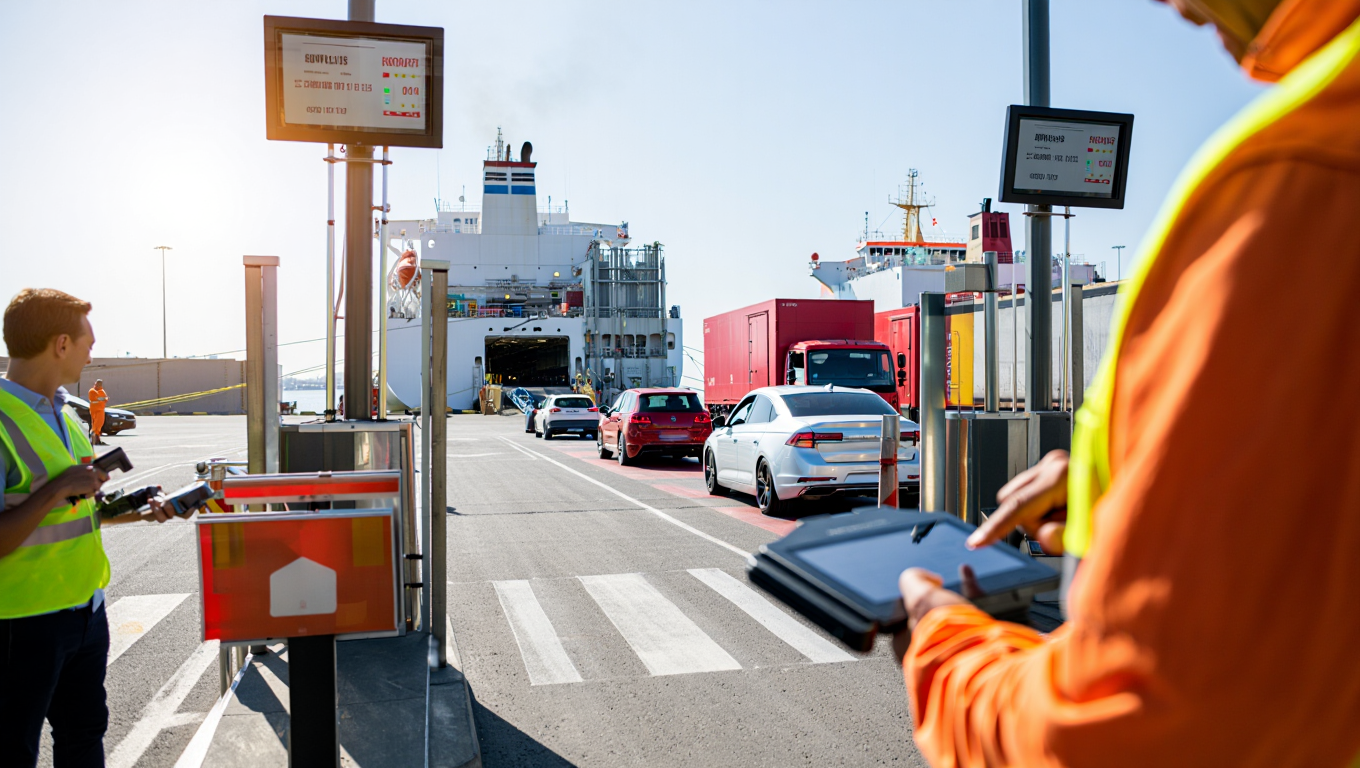
Digital RoRo booking process - how to optimally prepare your shipment
January 29, 2026
Reading time: 3 minutes
Brief overview: A modern roro booking process today is much more than „enquiry in, ship sails“. Digital workflows, clean master data and early compliance checks determine whether a vehicle or rolling project cargo runs smoothly through the port - or whether it fails at the cut-off, due to documents or technical specifications. This guide shows you step by step how to optimally prepare your RoRo shipment. We deliberately do not quote specific prices - a personalised quote is always required for reliable figures.
Why the digital RoRo booking process is the standard today
RoRo (roll-on/roll-off) is one of the most efficient transport methods for ready-to-move vehicles and machines. At the same time, the processes in the background have been heavily digitalised: Shipping companies, terminals and authorities work with booking portals, electronic reporting systems and standardised data records.
Since 2024, many ports have been obliged to record data electronically via Maritime Single Window Systems. The aim: less paper, fewer media disruptions and significantly higher process reliability. For shippers, this means one thing above all - data quality is crucial.
A cleanly structured roro booking process therefore does not begin in the harbour, but already during the internal preparation of your shipment.
The digital RoRo booking process in 8 steps
1. plan routing & departure realistically
The first step is to choose the right route. Decisive factors are not only departure days, but also gate-in times and cut-offs. These are often several days before the actual departure.
Always plan backwards from the planned departure and take into account lead times, document processing times and possible delays.
Once the preparations have been completed, the booking is submitted digitally. After confirmation, you will receive a booking reference and the allocation to the planned departure.
A professional roro booking process ensures that all data is stored correctly before gate-in.
6. handover at the terminal (gate-in)
At the gate-in, the vehicle is inspected and documented. In many cases, a photographic record of the condition is taken.
Vehicle cleaned
Interior empty
Previous damage documented
Tank or battery level according to specifications
7. correctly interpret tracking and status messages
Digital systems provide numerous status messages - but these milestones are particularly relevant:
Status
Meaning
Gate-in
Vehicle accepted at the terminal
Loaded on Vessel
Vehicle is on board
Sailed
Ship has sailed
Arrived
Ship arrives at port of destination
8. arrival and release at the port of destination
Ideally, prepare the import process before the ship arrives. This avoids idle times and delays.
Checklist: Is your RoRo booking ready?
Timetable and cut-off checked
Dimensions and weight correctly recorded
Technical specifications clarified
Documents complete and consistent
Gate-in prepared
Tracking set up
Common errors in the RoRo booking process
Dimensions are estimated instead of measured
Documents are submitted too late
Loose objects in the vehicle
Too little time buffer before the cut-off
Status messages are interpreted incorrectly
FAQ - Digital RoRo booking process
What data is crucial for the RoRo booking process?
Exact dimensions, weight, roadworthiness and all safety-relevant information.
Why is the cut-off so important?
After the cut-off, terminals generally do not accept any further vehicles - even if the ship has not yet cast off.
Is RoRo fully digital possible?
Many processes are digitalised, but certain original documents may still be required depending on the country.
How do I avoid delays at the port of destination?
By preparing the import release before arrival.
Conclusion
A structured roro booking process ensures planning reliability, minimises risks and reduces delays. Those who think digitally, prepare properly and plan realistically will get their RoRo shipments to their destination efficiently.
Note: Specific prices are deliberately not quoted as they depend heavily on the route, vehicle type, season and availability. A personalised offer is required for a reliable calculation.
Disclaimer: All information in this article has been carefully researched but is subject to change at any time. ODS Orient accepts no liability for the topicality, accuracy and completeness of the information provided.
Do you have any questions or would you like to make use of our RoRo service?
RoRo construction machinery transport is one of the most efficient methods of shipping construction machinery internationally. Vehicles are driven directly onto a RoRo ship via a ramp. Technical factors such as ramp angle, ground clearance and machine dimensions are decisive. In addition, documents such as B L, ETD ETA information as well as POL and POD must be prepared correctly. In practice, the [...]
The decision between RoRo and container transport depends heavily on the type of cargo, the route and the safety requirements. When comparing ro-ro vs container, it is often found that ro-ro is particularly efficient for vehicles ready to travel or heavy machinery, while container solutions offer more protection and flexibility for sensitive or smaller cargo. In practice, the decisive factor is often [...]