
Brief overview: A modern roro booking process today is much more than „enquiry in, ship sails“. Digital workflows, clean master data and early compliance checks determine whether a vehicle or rolling project cargo runs smoothly through the port - or whether it fails at the cut-off, due to documents or technical specifications. This guide shows you step by step how to optimally prepare your RoRo shipment. We deliberately do not quote specific prices - a personalised quote is always required for reliable figures.
RoRo (roll-on/roll-off) is one of the most efficient transport methods for ready-to-move vehicles and machines. At the same time, the processes in the background have been heavily digitalised: Shipping companies, terminals and authorities work with booking portals, electronic reporting systems and standardised data records.
Since 2024, many ports have been obliged to record data electronically via Maritime Single Window Systems. The aim: less paper, fewer media disruptions and significantly higher process reliability. For shippers, this means one thing above all - data quality is crucial.
A cleanly structured roro booking process therefore does not begin in the harbour, but already during the internal preparation of your shipment.
The first step is to choose the right route. Decisive factors are not only departure days, but also gate-in times and cut-offs. These are often several days before the actual departure.
Always plan backwards from the planned departure and take into account lead times, document processing times and possible delays.
To the current RoRo timetables
Incorrect or incomplete master data is one of the most common causes of delays in the RoRo booking process.
Tip: Always measure the vehicle at the highest and widest point and document the measurements with photos.
Not every vehicle is automatically RoRo-compatible. The following are particularly relevant:
Structured preparation helps to avoid rejections at the terminal.
Digital processes only work with clean documents. Depending on the destination, these may be required:
It is important that names, addresses and vehicle data are identical in all documents.
What you need to consider for a RoRo shipment
Once the preparations have been completed, the booking is submitted digitally. After confirmation, you will receive a booking reference and the allocation to the planned departure.
A professional roro booking process ensures that all data is stored correctly before gate-in.
At the gate-in, the vehicle is inspected and documented. In many cases, a photographic record of the condition is taken.
Digital systems provide numerous status messages - but these milestones are particularly relevant:
| Status | Meaning |
|---|---|
| Gate-in | Vehicle accepted at the terminal |
| Loaded on Vessel | Vehicle is on board |
| Sailed | Ship has sailed |
| Arrived | Ship arrives at port of destination |
Ideally, prepare the import process before the ship arrives. This avoids idle times and delays.
Exact dimensions, weight, roadworthiness and all safety-relevant information.
After the cut-off, terminals generally do not accept any further vehicles - even if the ship has not yet cast off.
Many processes are digitalised, but certain original documents may still be required depending on the country.
By preparing the import release before arrival.
A structured roro booking process ensures planning reliability, minimises risks and reduces delays. Those who think digitally, prepare properly and plan realistically will get their RoRo shipments to their destination efficiently.
Note: Specific prices are deliberately not quoted as they depend heavily on the route, vehicle type, season and availability. A personalised offer is required for a reliable calculation.
Disclaimer: All information in this article has been carefully researched but is subject to change at any time. ODS Orient accepts no liability for the topicality, accuracy and completeness of the information provided.
A motorhome is more than just a vehicle - it is a travelling companion, a home on wheels and often a considerable investment. Anyone who wants to transport it by sea is quickly faced with the key question: container vs roro for motorhome - Which method really suits the vehicle, route and risk profile? This is exactly where most wrong decisions are made: People only look at „fast“ or „protected“ and overlook details such as dimensional limits, port processes, loading rules, battery or gas regulations and customs requirements.
This guide provides you with a practical decision-making aid. You will find out when RoRo (roll-on/roll-off) is the more efficient choice, when the container offers more control - and which preparation steps are mandatory regardless of the method. We deliberately do not quote specific prices, as costs depend heavily on the route, season, vehicle data and availability. For reliable figures, a personalised offer required.
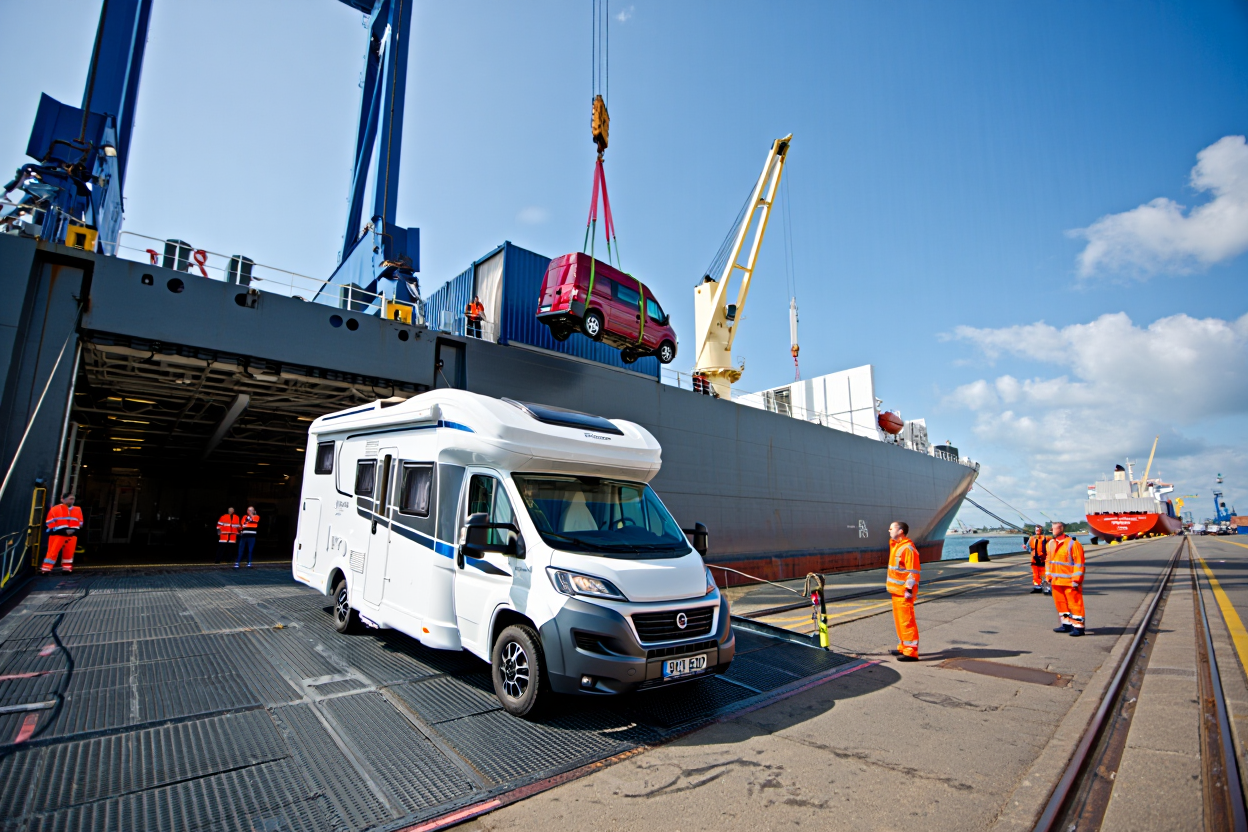
With RoRo, the motorhome drives directly onto the ship on its own axle via a ramp. This reduces handling points and simplifies the process considerably. The prerequisite is that the vehicle is ready to drive.
During container transport, the motorhome is loaded into a sea container. This offers additional protection from the weather and external access, but requires precise dimensional checks and professional load securing.

| Criterion | RoRo | Container |
|---|---|---|
| Size & weight | Very good for large motorhomes | Limited by container dimensions |
| Protection | Limited | Very high |
| Readiness to drive | Required | Not mandatory |
| Handling effort | Low | Higher (securing & packaging) |
| Route availability | Depending on RoRo lines | Globally available |
Helpful for preparation:
The CTU Code applies internationally for safe load securing: IMO CTU Code
The decision between container vs roro for motorhome always depends on the vehicle type, route and individual requirements. RoRo impresses with its simplicity and efficiency for large, roadworthy motorhomes. The container scores with protection and flexibility. Individual advice and a personalised offer are essential for reliable planning.
Not necessarily. The cost-effectiveness depends on the route, season and vehicle data.
Generally not for RoRo. For containers, only after prior agreement and documentation.
Then container transport is usually the only option.
Extremely important - they decide on feasibility and mode of transport.
As early as possible in order to comply with availabilities and cut-offs.
Disclaimer: All information in this article has been carefully researched but is subject to change at any time. ODS Orient accepts no liability for the topicality, accuracy and completeness of the information provided.
With every RoRo shipment, proper preparation determines whether a vehicle is loaded smoothly - or whether it fails at the terminal. In practice, delays rarely occur at sea, but almost always at the port: missing documents, vehicles that are not ready to travel or discrepancies between registration and actual condition. This is precisely where this roro loading checklist to.
The following guide shows you step by step how to prepare vehicles, machines or rolling project cargo for the RoRo port without errors. You will find out which technical requirements apply, which documents are mandatory and which typical mistakes you should avoid at all costs. The aim is loading roro, which goes through without any queries, additional costs or delays.
RoRo stands for „roll-on/roll-off“ - vehicles are moved on board ready to travel. This is precisely the advantage, but also the responsibility of the shipper. Unlike with containerised loads, the terminal checks very carefully before loading whether the vehicle is ready to move:
Even small deviations result in units not being accepted. A structured roro loading checklist is therefore not a „nice-to-have“, but a must for predictable shipping.
The most important principle is: Anything that cannot roll on its own is not loaded. The following points should therefore be checked and documented before delivery to the harbour:
For construction machinery, agricultural machinery or special vehicles in particular, this point is crucial for successful RoRo loading.
The reported dimensions are the binding basis for every RoRo booking. Deviations often lead to rejection at the terminal.
| Parameters | What to look out for |
|---|---|
| Length | incl. attachments, overhangs, couplings |
| Width | incl. mirrors, chains, safety bars |
| Height | incl. roof superstructures, antennas |
| Weight | Unladen weight plus fixed attachments |
Practical tip: Always measure the real vehicle and do not rely solely on data sheets. Conversions or optional extras are often forgotten.
Error-free documentation is a core element of every roro loading checklist. The following documents should be available at the latest at gate-in:
You can also find a general overview of processes and requirements here: What do I need to consider for a RoRo shipment?.
Each port sets its own deadlines and procedures. Typical points are
Late delivery or lack of advance notification may result in the unit being postponed to the next departure.
Further details can be found in the overview: RoRo shipping - procedure & advantages.
All of these points can be addressed with a structured roro loading checklist reliably.
International safety standards for maritime transport are defined, among other things, by the International Maritime Organisation (IMO) defined. These specifications form the basis for many port and shipping company regulations in RoRo transport.
Yes, vehicles that cannot roll independently are unsuitable for classic RoRo shipments.
The specified dimensions must correspond to the actual condition. Deviations often lead to rejection in the terminal.
As a rule, yes. The permitted quantity depends on the shipping company and harbour.
Ideally several days before the gate-in in order to rectify technical or documentary problems in good time.
Structured preparation is the key to a successful RoRo shipment. This roro loading checklist helps you to avoid typical mistakes and get your units through the harbour without delays. Specific prices are deliberately not quoted, as costs depend on the route, vehicle type and harbour. A personalised quote is required for reliable figures.
Disclaimer:
All information in this article has been carefully researched but is subject to change at any time. ODS Orient accepts no liability for the topicality, accuracy and completeness of the information provided.
The demand for predictable transport solutions to North Africa remains high - and Algeria is one of the more demanding target markets. Whoever wants a Shipment to Algeria The transport company must not only choose the right route and mode of transport, but must above all ensure that documents, customs processes and harbour procedures are properly synchronised. Even minor discrepancies between the invoice, packing list and freight documents can lead to delays. At the same time, the Algerian seaports offer a solid infrastructure for container, RoRo and project cargo, provided the shipment is prepared correctly.
This guide provides you with a practical overview of routes, process steps, typical cost factors (without specific prices), customs requirements and best practices. The aim is for you to shipping algeria 2025 - from booking to release at the port of destination. A personalised offer is always required for individual costs and a reliable calculation, as conditions vary greatly depending on the cargo, season, shipping company, equipment and port.
Algeria is a large import market, but at the same time the formal requirements for import and clearance are often stricter in practice than in many other destinations. Frequent success factors are:
For time-critical projects in particular, it is worth considering the entire process as a process chain. Favourable sea freight alone is not enough if downtimes or additional demands increase the overall costs.
Most routes for the Shipping Algeria sail via the Mediterranean. Departures from Northern Europe are usually transhipped, from Southern Europe more often direct. In addition to the pure transit time, cut-off times, terminal utilisation and local public holidays should be taken into account.
For operational planning, we always recommend using the latest Timetables, to define realistic departure and arrival windows.
Suitable for palletised goods, machines, spare parts and consumer goods. A particularly precise goods description is crucial for Algeria.
Ideal for roadworthy vehicles, lorries and construction machinery. The technical condition and correct documents are important. Find out more at What do I need to bear in mind for a RoRo shipment?.
For oversized or heavy goods. Technical drawings, exact dimensions and proper stowage planning are essential here.
| Cost area | Influencing factors |
|---|---|
| Sea freight | Route, season, shipping company, equipment |
| Terminal & Handling | Harbour, type of loading, idle times |
| Customs & Documents | Product group, inspection effort |
| Lead / Lag | Distance, vehicle type, time window |
Specific prices cannot be reliably quoted without details. A personalised quote is always required for individual costs.
Image description (optional): Container terminal with stacked containers and RoRo ship in the background. Alt text: „Container and RoRo shipping to Algeria in comparison“.
Customs clearance is often the most critical point in the Shipment to Algeria. Central documents are:
An internationally recognised reference for safe packaging and load securing is the IMO - CTU Code.
The duration depends on the route, port of departure and clearance processes. In addition to the sea transit time, a buffer should always be planned for the terminal and customs.
No. The costs are individual and depend on many factors. A personalised quote is required.
Yes, especially for vehicles and mobile units, provided they are correctly prepared and documented.
Through complete, consistent documents and early coordination with the local importer or customs agent.
The shipping algeria in 2025 requires structured planning, clear documentation and realistic timeframes. Coordinating the type of transport, route and customs processes at an early stage reduces risks and avoids unnecessary additional costs. For a reliable calculation, the following applies: individual requirements always require a personalised offer.
Disclaimer: All information in this article has been carefully researched but is subject to change at any time. ODS Orient accepts no liability for the topicality, accuracy and completeness of the information provided.
With ports such as JNPA/JNPT, Mundra, Chennai/Ennore, Kolkata/Haldia and Cochin, India is one of the most dynamic maritime trade markets in Asia. At the same time, clear import and reporting obligations apply: Imports are made electronically via ICEGATE or CBIC. Those who submit their consignment data correctly and in full reduce idle times and additional costs - and ensure smooth processing.
The most common routes are via the Mediterranean, the Suez Canal and the Arabian Sea to the west coast or further into the Bay of Bengal to the east coast.
Important destination ports:
Tip: Check live timetables and plan for seasonal effects (monsoon, storms) and Suez bypasses. See: Timetables
| Criterion | RoRo | Container (FCL/LCL) |
|---|---|---|
| suitability | Roadworthy vehicles | General cargo, dismantled vehicles |
| packaging | Low | Higher (stowage, lashing) |
| handling points | Few, gentle | Multiple envelopes |
| Cost logic | Dimensions, weight, deck area | Equipment & stowage |
| risks | Sea state, terminal handling | Handling risks |
| Special cases | High & Heavy, Machines | Accessories, spare parts |
Practice: Ready-to-run vehicles = RoRo. The container is better for spare parts or parts collections. Details on RoRo preparation: What do I need to bear in mind for a RoRo shipment?
On the export side:
On the import side (India):
Official sources:
| process step | Typical time window | Notes |
|---|---|---|
| document cut-off | 2–5 working days before ETD | Carrier-dependent |
| Gate-In | 2–3 working days before ETD | Confirm slot |
| B/L creation | After departure (Sailed) | Plan corrections |
| Destination port status | Before ETA/upon arrival | Use for exemption |
| collection | ETA + X days | Avoid demurrage charges |
Before booking:
During the booking process:
After departure:
| Category | Mandatory information | Additional info |
|---|---|---|
| load | VIN, dimensions, weight | Photo documentation, modifications, list of accessories |
| Routing | Port of destination, ETD/ETA | Alternative ports |
| Documents | Invoice, packing list, B/L, MRN | HS code, country of origin, tax ID |
| permits | Registrations depending on goods | BIS/FSSAI/DGFT references |
| Insurance | Policy & cover | GA, deductible, door-to-door |
Note: Observe health/quarantine regulations for certain goods - consultation with import agent necessary.
How long does it take to ship to India by sea?
Several weeks depending on the route. Note seasonal influences & harbour location. Use live timetables.
Do I need special import authorisations?
Depending on the type of goods. Many goods require registrations (e.g. BIS, FSSAI, DGFT). Check ICEGATE/CBIC.
RoRo or container - which is better?
RoRo for roadworthy vehicles, containers for spare parts & sensitive goods.
Which documents are mandatory?
Invoice, packing list, bill of lading, export customs (MRN), bill of entry in India via ICEGATE.
What does shipping to India cost?
Depending on cargo, harbour, service & season. Prices only on request.
How can I avoid delays?
Complete documents, clarify import specifications early on, observe live schedules & cut-offs.
Shipping India is a success if the data quality, documentation and timings are right. Those who plan early, use live schedules and prepare cargo correctly will meet deadlines - whether via RoRo or container. For reliable prices and transport solutions, we recommend a customised offer.
Disclaimer: All information in this article has been carefully researched but is subject to change at any time. ODS Orient accepts no liability for the topicality, accuracy and completeness of the information provided.
The shipping industry is under pressure to measurably reduce its CO₂ emissions. Globally, the IMO relies on two levers: EEXI as a technical efficiency index for existing ships and CII as an annual operational rating. At the same time, the EU is tightening the fuel pathway with FuelEU Maritime and EU-ETS. For exporters, this means that routes, offers and documents must be set up to be emissions-compliant.
More about current departures:
Timetables – ODS Orient
Processes in RoRo export:
Customs clearance for RoRo shipments
Assesses the technical efficiency of an existing ship. Shipowners achieve compliance through measures such as engine power limitation, propeller upgrades or waste heat utilisation.
Measures the CO₂ intensity per transport performance over the course of the year. Result: A-E rating. Poor ratings require operational correction plans.
In discussions, „UEFI“ usually stands for EU regulations such as FuelEU Maritime. Important: EEXI/CII = IMO, FuelEU = EU.
Official overview:
IMO - EEXI & CII
European Commission - FuelEU Maritime
Carriers integrate emissions data (gCO₂/tkm, WtW/WtT) into quotes. Shippers should request binding KPIs in RFQs.
To comply with CII targets, the vehicle is driven more slowly or routed differently. Use flex windows and live timetables:
Timetables – ODS Orient
Clean export/import documents and gate-ready specifications help to avoid downtimes and emissions. For details:
Customs clearance for RoRo shipments
One-off technical assessment, e.g. by:
Slower driving can influence transit times.
Annual A-E rating based on CO₂ per transport job. Poor ratings (D/E) lead to mandatory measures. CII data is increasingly visible in offers - important for Scope 3 reporting.
Goal: Reduce the GHG intensity of marine fuels. Shipowners must use or compensate for low-carbon fuels. Shippers see the prospect of CO₂ cost components in the offer.
Instrument
EEXI - IMO, technical efficiency, indirectly relevant via speed
CII - IMO, operational CO₂ intensity, A-E rating visible
FuelEU Maritime - EU, GHG intensity of fuel, influences offers
IdentificationBooking number, IMO no., recipient
loadDimensions, weight, VIN
RoutingPorts, ETD/ETA
DocumentsInvoice, Packing list, MRN
emissionsMethodology, unit, CII rating if applicable
Is „UEFI“ an official IMO term?
No - usually FuelEU Maritime is meant.
What is the difference between EEXI and CII?
EEXI = technology (one-off), CII = operation (annual).
Do the rules affect timetables?
Yes - through speed/routing adjustments.
Which documents are critical?
Invoice, packing list, B/L, MRN; for RoRo: gate-ready standards.
What does this mean for my budget?
CO₂ cost components may occur. An individual offer is required for details.
A practical eexi uefi declaration means: clarity about the control sources, clean KPI requirements, well thought-out planning - and documentation that can be used for emissions. If you get this right today, you can export safely, sustainably and predictably in 2025/2026.
Disclaimer: All information in this article has been carefully researched but is subject to change at any time. ODS Orient accepts no liability for the topicality, accuracy and completeness of the information provided.
From 1 January 2026, the International Maritime Organisation (IMO) will be tightening its climate targets. The focus is on more binding efficiency paths for ships, stricter inspection obligations for shipping companies and concrete preparatory steps for global CO₂ pricing. For exporters, this means more transparency, more documentation - and potentially higher CO₂ cost components.
Immediately helpful:
Timetables → https://odsorient.com/fahrplaene
What do I need to bear in mind when shipping by RoRo? → https://odsorient.com/was-muss-ich-bei-einer-roro-verschiffung-beachten
The phase 2 revision of these instruments will start in 2026. The CII pathway will be tightened, gaps closed and integration into national roadmaps prepared.
| Period | Measure | Relevance |
|---|---|---|
| 2024–2025 | Phase 1 review | Carriers optimise fleets & routes |
| from 2026 | Phase 2 launch | Sharper CII targets & more control |
| 2027–2030 | Progressive CII targets | Annual increase in efficiency necessary |
| from 2028 ff. | Fuel/pricing elements | Visible CO₂ costs in offers |
You should specifically request CO₂ KPIs in tenders:
Carriers often plan with adjusted transit times due to CII requirements. Use A/B departures and keep a flex window open:
Timetables → https://odsorient.com/fahrplaene
Proper preparation prevents delays and emissions caused by subsequent travelling:
What do I need to bear in mind when shipping by RoRo? → https://odsorient.com/was-muss-ich-bei-einer-roro-verschiffung-beachten
| scenario | CO₂ transparency | Risk | Recommendation |
|---|---|---|---|
| base | rudimentary | high | 2. departure + alerts |
| Advanced | standardised | moderate | KPIs in RFQ, gate-ready SLA |
| leader | granular | low | Contract KPIs, test with NZF services |
What specifically will change from 2026 onwards?
More binding CII targets, stricter rectification obligations, more emissions data in offers.
Do I have to report as an exporter?
No - but you should actively demand emissions-related KPIs.
Are freight rates rising?
Possible - depending on route, carrier and efficiency. Please ask for an individual offer.
What is the difference between EEXI and CII?
EEXI = technical efficiency, CII = operational efficiency.
Do other regulations apply?
Yes - e.g. EU-ETS and FuelEU Maritime in addition to IMO.
The 2026 IMO CO₂ regulations are a milestone on the road to climate-neutral shipping. Those who integrate CO₂ key figures into their tenders and processes at an early stage, utilise flexible routing and work with data-strong partners will secure competitive advantages - even with dynamic carrier strategies.
Disclaimer: All information in this article has been carefully researched but is subject to change at any time. ODS Orient accepts no liability for the topicality, accuracy and completeness of the information provided.
RoRo (roll-on/roll-off) is a fast and robust shipping method for roadworthy vehicles. Nevertheless, many customers find the transport process unclear – especially when status information is scattered across emails, portals and PDF notifications. A structured RoRo tracking system brings order to this diversity of data and provides a clear timeline:
Helpful for planning:
Timetables and What do I need to bear in mind for a RoRo shipment?
Carriers and terminals report standardised events, usually as EDI data or in the booking portal. Important milestones are:
Tip: Data such as VIN, dimensions and booking number must match exactly – otherwise there is a risk of queries or status stops.
AIS (Automatic Identification System) provides real-time data on ship positions, which can be accessed via the IMO number or ship name. This allows ETA deviations to be identified at an early stage.
Important: AIS shows the ship – not your vehicle. It does not replace booking events.
Official basis: IMO - CTU Code
Documents also have „events“: for example, draft B/L confirmed, original/telex release completed or customs clearance granted. Collection is not possible without all the necessary documents.
Further information:
What do I need to bear in mind for a RoRo shipment?
Category – Must-have – Nice-to-have
Strengths: Live position, course, speed, ETA
Limits: No vehicle tracking, patchy coverage, no status events
Best practice: Always use in combination with EDI events
How often should I check the status?
With alerts activated, one glance per event is sufficient – additionally, check the AIS ship daily in case of bottlenecks.
Can I track my vehicle via GPS?
Usually not permitted – for safety and liability reasons. Utilise EDI and AIS tracking.
Why does AIS ETA differ from carrier ETA?
AIS ETA is based on speed/course, while carrier ETA is based on port slots – the latter is more relevant.
What to do if there is no gate-in?
Contact the carrier or terminal immediately. VIN, dimensions or photos are often missing.
How much does a good tracking system cost?
Depending on the range of functions and interfaces – an individual quote is required for precise details.
A good roro tracking system combines milestones, AIS and document status to create a comprehensible timeline. Careful planning reduces delays, lowers costs and improves predictability along the entire transport chain.
To do this, use timetables, keep vehicles gate-ready – and always link AIS with events and document status.
Disclaimer: All information in this article has been carefully researched but is subject to change at any time. ODS Orient accepts no liability for the topicality, accuracy and completeness of the information provided.
From 1 January 2026, stricter climate regulations from the International Maritime Organisation (IMO) will come into force. These relate in particular to CO₂ efficiency, emissions transparency and preparation for global pricing mechanisms. For exporters, this means more data, more responsibility – and more planning effort.
Key elements include stricter CII targets for 2027–2030, new auditing and reporting requirements, and initial market instruments for CO₂ pricing. Those who set the right course today will ensure operational stability and strengthen their own sustainability balance sheet.
Assess the technical efficiency of existing ships, for example through power limitation or optimisations to the hull.
Measures annual CO₂ intensity in gCO₂ per tonne-kilometre. Shipping companies must gradually improve their fleets. Poor ratings (D or E) require improvement.
Energy management plan at ship level with CII monitoring and catalogue of measures in case of deviations.
Collects operational data on fuel consumption and emission factors as a basis for audits and reports.
Political and technical framework for the introduction of fuel standards and pricing elements from 2028 onwards.
Offers increasingly include CO₂ figures such as gCO₂/tkm or well-to-wake values. Check:
Driving more slowly to increase efficiency may result in changed ETAs. Recommendation:
In addition to the standard documentation, RoRo transports require:
Notes:
What do I need to bear in mind for a RoRo shipment?
| scenario | setup | CO₂ transparency | Risk | Recommendation |
|---|---|---|---|---|
| base | 1 carrier, fixed ETD | rudimentary (PDF) | high | Plan A/B departures |
| Advanced | 2 carriers, flexible windows | standardised (gCO₂/tkm) | moderate | Define KPIs in RFQ |
| leader | Multi-carrier, CO₂ target | granular (WtW, IMO) | low | Use bonus/penalty clauses |
What specifically will change from 2026 onwards?
More binding CII requirements, stricter audits and more emissions data in tenders.
As an exporter, do I have to report to the IMO myself?
No, but you should request and document CO₂ KPIs (Scope 3).
Will freight rates rise as a result of the new rules?
Additional CO₂ costs possible, exact figures only available on quotation basis.
What is the difference between EEXI and CII?
EEXI measures technical efficiency, CII measures operational CO₂ intensity.
Are there any additional regional regulations?
Yes, e.g. EU ETS or FuelEU Maritime depending on the route.
The IMO CO₂ regulations for 2026 bring more responsibility, but also more controllability. Those who use CO₂ data intelligently, create flexibility in logistics and enforce gate-ready standards will remain able to deliver – even with dynamic CII adjustments.
Plan ahead, rely on transparent partners and secure reliable CO₂ data for a sustainable export business.
Disclaimer: All information in this article has been carefully researched but is subject to change at any time. ODS Orient accepts no liability for the topicality, accuracy and completeness of the information provided.
RoRo (roll-on/roll-off) is fast, robust and ideal for roadworthy vehicles. Nevertheless, some shipments feel opaque – especially when status updates are scattered across emails, portals and PDF notifications. A structured RoRo tracking system brings these pieces of the puzzle together into a clear timeline:
Directly useful for planning: Timetables and What do I need to bear in mind for a RoRo shipment?
Carriers and terminals generate standardised status messages – e.g. as EDI events such as CODECO or COARRI. The most important milestones:
Important: VIN, dimensions and other data must be accurate – otherwise queries or status stops will occur.
AIS (Automatic Identification System) transmits ship positions via IMO numbers. This helps to identify ETA deviations at an early stage. AIS is regulated internationally (SOLAS). Official guidelines are provided by the IMO - CTU Code.
However, AIS only shows the ship, not the vehicle. Therefore, always use AIS in combination with booking events.
B/L status, telex release and customs clearance are crucial. Without them, even a perfect ETA is useless – because exemption depends on them.
Further information: What do I need to bear in mind for a RoRo shipment?
Set key points such as gate-in, loaded, sailed, arrived, discharged and release. Assign responsibilities.
Set alerts for important events – e.g. via email or app.
Look up the IMO number of the ship and enter it in the shipment file.
Decide early on whether you will work with original B/L or telex release. Check all fields in the B/L draft carefully.
Customs clearance should commence upon arrival of the event. Allow for buffer times for collection and storage.
Combine AIS with carrier information to respond flexibly to ETD/ETA changes.
Category – Must-have – Nice-to-have
Identification – booking number, VIN, recipient – contact person, customs IDs
Specifications – dimensions, weight, drive type – photos, special superstructures
Routing – Port of departure/destination, ETA – Alternative ETD, terminal information
Documents – invoice, packing list, MRN – certificate of origin, insurance policies
Tracking – milestones, IMO no. – notifications, escalation rules
Advantages:
Limits:
Tip: Always combine with EDI.
How often should I check the status?
Alerts are sufficient for key events. In addition, check the AIS daily in case of bad weather or traffic jams.
Can I use a GPS tracker in my vehicle?
Often not permitted. Safety and liability issues. EDI and AIS are standard.
Why do AIS ETA and carrier ETA sometimes not match?
AIS uses course/speed, carrier ETA is based on port windows. The latter is more reliable for pick-up planning.
What to do if „Gate-In“ is missing?
Follow up with the freight forwarder or terminal – VIN verification or photos are often missing.
How much does a tracking system cost?
Depending on the range of functions. Please request an individual quote for prices.
A good roro tracking system combines EDI milestones, AIS ship positions and document statuses to create a reliable timeline. This allows you to identify deviations early on, avoid demurrage charges and organise transfers efficiently. Pay attention to data quality and consistent workflows, and use the schedules provided by ODS Orient for smooth planning.
Disclaimer: All information in this article has been carefully researched but is subject to change at any time. ODS Orient accepts no liability for the topicality, accuracy and completeness of the information provided.
