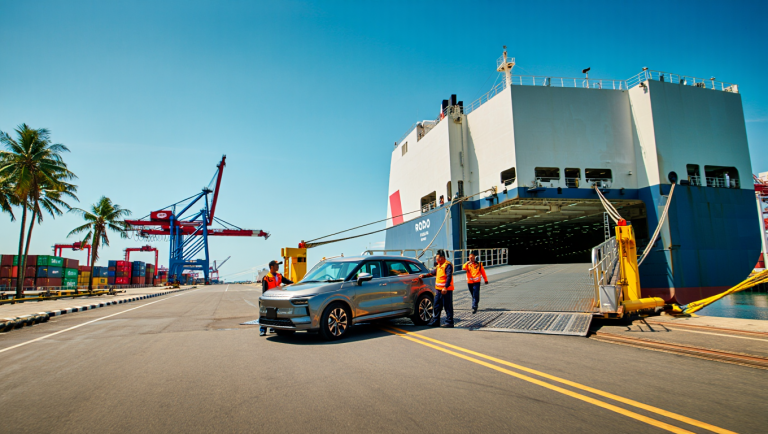
The demand for vehicle, project and construction machinery transport from Europe to South America will increase noticeably in 2025. Car manufacturers are relocating production lines to Brazil, mining companies are modernising their fleets in Chile and construction companies in Colombia are relying on imported crawler excavators. For shippers, one thing therefore counts above all: reliable RORO transit times in 2025. This guide shows the ten fastest RoRo routes, explains transit time drivers and offers practical checklists - so that your roll-on/roll-off shipment arrives on time.
1 - Introduction - why transit times are becoming strategically more important
Since the pandemic, shipping companies have reshuffled their schedules; the Panama Canal is suffering from periods of low water, and European ports are implementing strict environmental regulations. At the same time, South American authorities are tightening customs processes to curb illegal imports. The result: RORO transit times in 2025 are more volatile than ever. Those who calculate them realistically will gain planning security, reduce buffer stocks and achieve projects on schedule - without unpleasant demurrage surprises.
Continuing: What do I need to bear in mind for a RoRo shipment?
2 - Data basis & methodology
- Sources: AIS live tracking of five ro-ro carriers, port ETA reports (Q1 - Q2/2025) and UNCTAD LSBCI database.
- Route definition: POL (Port of Loading) in Northern Europe or the Mediterranean → POD (Port of Discharge) on the east or west coast of South America.
- Transit time: Sea days from Vessel Departure to First Line Ashore; pre-/post-carriage not included.
- Carrier basis: Top 5 RoRo lines (Grimaldi, Höegh, Wallenius Wilhelmsen, NYK RoRo & Glovis).
(Image suggestion: Heat-map "Europe → South America RoRo Flows 2025", alt-text: "Map shows main lines & frequency")
3 - Top 10 routes - ranking by fastest average transit time
| Rank | Route (POL → POD) | Distance (nm) | Ø Transit 2025 (days) | Departure frequency* |
|---|---|---|---|---|
| 1 | Vigo → Santos | 4 790 | 16 days | weekly |
| 2 | Bremerhaven → Rio de Janeiro | 5 300 | 17 days | 10 d |
| 3 | Zeebrugge → Montevideo | 6 000 | 18 days | 12 d |
| 4 | Southampton → Buenos Aires | 6 350 | 19 days | 2 ×/month |
| 5 | Antwerp → Callao (Peru) | 6 820 | 22 days | 2 ×/month |
| 6 | Koper → Santos | 5 850 | 22 days | 15 d |
| 7 | Hamburg → Cartagena (COL) | 5 230 | 23 days | 10 d |
| 8 | Livorno → Itajaí | 5 920 | 24 days | 3 ×/month |
| 9 | Valencia → Suape (PE) | 4 780 | 25 days | weekly |
| 10 | Le Havre → Paranaguá | 5 700 | 25 days | 2 ×/month |
*Frequency refers to 2025 confirmed carrier slots (as of June 2025).
4 - Main drivers for runtime differences
- Currents & weather windows
North Atlantic drift favours Vigo-Santos (rank 1).
El Niño-related storm fields extend North Sea → Rio routes by Ø 1 day. - Panama Canal vs. Magellan Pass
West coast destinations such as Callao benefit from the Panama Canal; drought 2024/25 reduces lockages, therefore rank 5 only 22 days. - Port infrastructure & gate efficiency
Santos invested in a second RoRo ramp system in 2024 → faster First Line Ashore.
Buenos Aires suffered from dock renovations, +2 days delay Q1 2025. - Carrier fleet mix
New 7,000-CEU ships with dual fuel (Höegh, Grimaldi) travel 2 kn faster with the same EEXI profile.
5 - Checklist: How to make the most of the fastest route
| Phase | To-do | Done |
|---|---|---|
| Routing | Check distance + weather forecast (6-week forecast) | ☐ |
| Slot booking | Align carrier ETA vs. project deadline | ☐ |
| Documents | Export, ATA Carnet (if temporary), VGM | ☐ |
| Customs Brazil | Siscomex pre-registration 48 h before ETA | ☐ |
| Corrosion protection | VCI film for tropical route | ☐ |
| Survey | Pre-shipment survey for value > €100,000 | ☐ |
6 - Influence of environmental regulations 2025
RoRo carriers must comply with higher CII ratings (IMO roadmap). Dual-fuel ships with LNG tanks dominate Atlantic services, as LNG bunkering has been expanded in Vigo, Antwerp and Santos. According to DNV Alternative Fuels Insight (AFI, April 2025) 38 % of the Atlantic-RoRo-Fleet already run on LNG or methanol - positive effect: +0.5 kn average speed with the same CO₂ emissions.
(External source: DNV AFI - Alternative Fuels Insight)
7 - FAQ
How reliable are the RORO transit times for 2025?
The values are average values from Q1-Q2 2025. Seasonal deviations ± 2 days are usual.
Does a direct call shorten my term?
Yes, Vigo → Santos Direct-Call (rank 1) saves 2 days compared to "Bremerhaven - Vigo - Santos".
Which documents speed up customs clearance in Brazil?
Pre-B/L, Siscomex pre-notification and correct NCM codes (HS equivalent).
Is RoRo insurance more expensive than container insurance?
Not mandatory. Premiums are based on value and risk. For exact costs: request a personalised quote.
8 - Conclusion
For fast RoRo transit times to South America in 2025, there is no way around Vigo → Santos or Bremerhaven → Rio. Distance, weather window and port efficiency remain decisive factors. Dual-fuel fleets optimise transit times, while Panama Canal restrictions slow down west coast routes. Those who check slot availability early on, digitalise customs processes and take corrosion protection into account deliver projects on time. ODS Orient can advise you on individual costs and customised routes at any time.
Disclaimer
All information in this article has been carefully researched but is subject to change at any time. ODS Orient accepts no liability for the topicality, accuracy and completeness of the information provided.