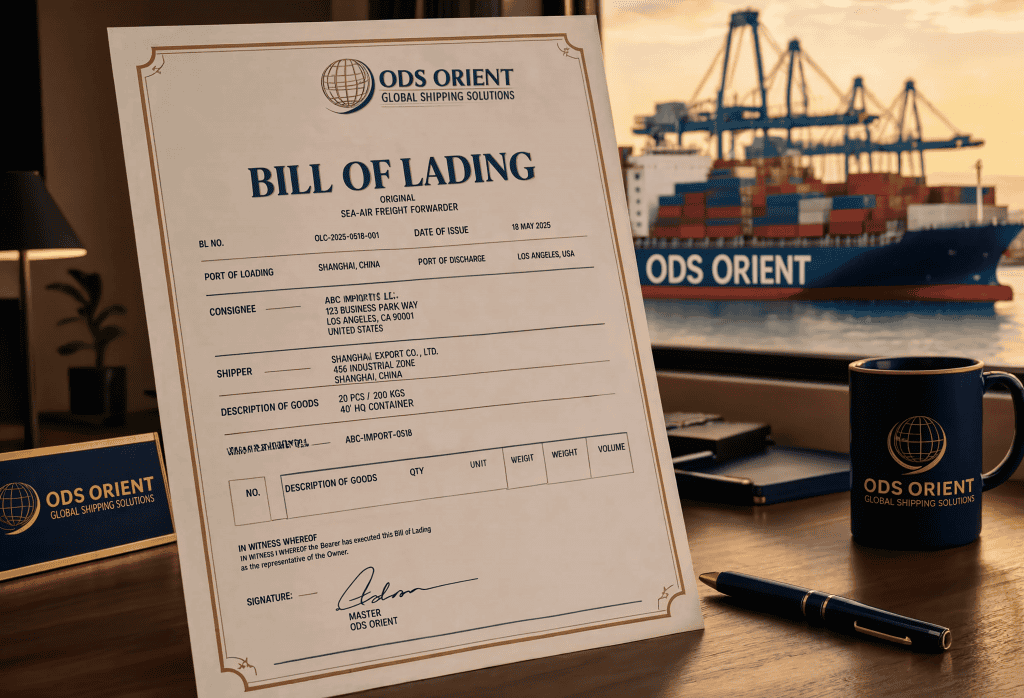
The Bill of Lading (B/L) is the key document for every RoRo shipment. It serves simultaneously as the shipping company’s acknowledgement of receipt, as a contract of carriage and as a title to the goods. Without a correctly issued B/L, the cargo cannot be released at the port of destination. There are various types, such as the original B/L, the Sea Waybill and the Telex Release – depending on the requirements of the shipment.
Short answer in 5 bullet points
- The bill of lading serves three purposes: as a receipt, a contract of carriage and a document of title.
- Without a B/L, the cargo cannot be released at the port of destination.
- There are various types: Original B/L, Sea Waybill and Telex Release.
- Incorrect details on the B/L may lead to delays and additional costs.
- The B/L should be carefully checked for accuracy before departure.
What is a bill of lading?
The Bill of Lading – often referred to as a B/L or consignment note – is the most important transport document in international maritime shipping. It is issued by the shipping company or its agent as soon as the cargo has been loaded on board.
In the context of Ro-Ro shipments, the B/L records which vehicle or vessel was taken on board, when, where and in what condition. It accompanies the entire journey and forms the basis for the release of the cargo at the port of destination.
Whether you are the sender or the recipient, it is essential that you understand the B/L and handle it correctly – as errors in this document can delay the entire process.
What are the three functions of a bill of lading?
In international maritime trade, the B/L fulfils three key functions:
Confirmation of Receipt (Receipt of Goods): The shipping company confirms that it took delivery of the cargo in a specific condition. This proof is important for insurance purposes and in the event of a claim.
Contract of Carriage: The B/L sets out the agreed terms of carriage – namely the route, the ports of departure and destination, and the responsibilities of both parties.
Title Deed (Document of Title): Anyone in possession of the original B/L has the right to take delivery of the cargo at the port of destination. This makes it a document similar to a security.
This threefold function makes the bill of lading an indispensable cornerstone of any shipment.
What types of bill of lading are there?
Depending on the transport requirements, different types of B/L are used:
| Type | Description of the | Title deed? |
| Original B/L | Issued in three original copies; physical dispatch required | Yes |
| Sea Waybill | Electronic document, not a title deed, faster processing | No |
| Telex Release | Shipping company releases cargo via electronic message | No (approval via message) |
The original B/L offers the highest level of security, but requires the physical dispatch of the documents. For many RoRo shipments, the telex release is the most practical solution, as it is quicker and less complicated.
How do you read a bill of lading correctly?
A typical B/L contains a great deal of information. You should check the following fields particularly carefully:
- Shipper (Sender): Your name or your company’s name – it must be exactly correct.
- Consignee: The person or company that collects the cargo at the port of destination.
- Notify Party: The party to be notified of the arrival.
- Port of Loading / Port of Discharge: Port of departure and port of destination.
- Description of Goods: Vehicle type, VIN number, weight and condition.
- Freight Terms: Indicates whether freight is paid in advance (prepaid) or on delivery (collect).
Any typing error in these fields may lead to problems with customs clearance or release. You should therefore always check the document before the ship sets sail.
What are the typical mistakes made with a B/L?
In practice, the same mistakes crop up time and again, even though they could be avoided:
- Incorrect or incomplete vehicle identification number (VIN)
- Discrepancies between the B/L and the commercial invoice regarding names or addresses
- Missing or incorrect details of the notify party
- Confusion between ‘Prepaid’ and ‘Collect’ in relation to freight charges
- Late requests for corrections once the ship has already set sail
Corrections made after the B/L has been issued are time-consuming and often incur a charge. Therefore, please ensure that all details are checked before the B/L is finally issued and that they are reconciled with the booking documents.
What practical tips are there for dealing with the B/L?
By following these guidelines, you can ensure that your B/L is correct and submitted on time:
Check the draft B/L: Always ask for a draft (Draft B/L) and check all the details before the final version is drawn up.
Keep copies in a safe place: Save digital copies of the B/L in several places – they are required for customs and insurance purposes.
Clarify the Telex release at an early stage: If you wish to use a Telex release, please check this with the shipping company before booking.
Communication with the recipient: Please ensure that the consignee at the port of destination receives all the necessary documents in good time.
Why is the B/L particularly important in RoRo operations?
In Ro-Ro transport, the B/L is of particular importance, as vehicles are identified individually. The VIN number on the B/L must match the actual vehicle exactly – otherwise, the port of destination will refuse to release the cargo.
Unlike with containerised cargo, where the cargo is identified by container numbers, in RoRo shipping the B/L serves as direct proof of which specific vehicle is being transported. This makes accuracy in this document particularly crucial.
You should therefore ensure, whenever you book a RoRo shipment, that the vehicle details, consignee information and terms of carriage on the B/L are correct.
FAQ - Frequently asked questions
What happens if the B/L is lost?
The loss of an original B/L is a serious problem, as it serves as a title to the goods. As a rule, a bank guarantee must be provided and a complex procedure must be followed before the cargo is released. A telex release avoids this risk.
What is the difference between a B/L and a Sea Waybill?
The original B/L is a title to ownership – whoever holds it is entitled to collect the goods. A Sea Waybill, on the other hand, is merely a proof of carriage without any transfer of ownership. The named consignee can collect the goods directly without having to present an original document.
Can I make changes to the B/L after it has been issued?
Changes are possible, but often involve fees and delays. It becomes particularly difficult once the ship has set sail. You should therefore check all the details before the tickets are finally issued.
Who issues the bill of lading?
The B/L is issued by the shipping company or its agents. If you book through a freight forwarder, you will usually receive a house B/L from the freight forwarder, whilst the shipping company issues a master B/L.
What exactly does ‘Telex Release’ mean?
With a telex release, the shipping company at the port of loading notifies its branch at the port of destination electronically that the cargo may be released – without the need to present an original B/L. This speeds up the process considerably.
Conclusion
The bill of lading is far more than just a piece of paper – it is the cornerstone of every RoRo shipment. As a receipt, a contract of carriage and a title to the goods, it fulfils three key functions that ensure your shipment runs smoothly.
By checking the B/L carefully, choosing the correct version and avoiding common mistakes, you’ll save time, money and hassle. If you’re unsure, an experienced freight forwarder can help you draw up all the documents correctly.
Do you have any questions or would you like a non-binding offer? Contact us directly: https://odsorient.com/kontakt
All information in this article has been carefully researched but is subject to change at any time. ODS Orient accepts no liability for the topicality, accuracy and completeness of the information provided.