Once your vehicle has arrived at the port of destination, customs clearance in the destination country will begin. For this, you will need the original bill of lading, a commercial invoice, the vehicle registration document and other country-specific documents. A local customs agent will handle the clearance on site. Storage charges will apply if customs clearance is delayed.
Short answer in 5 bullet points
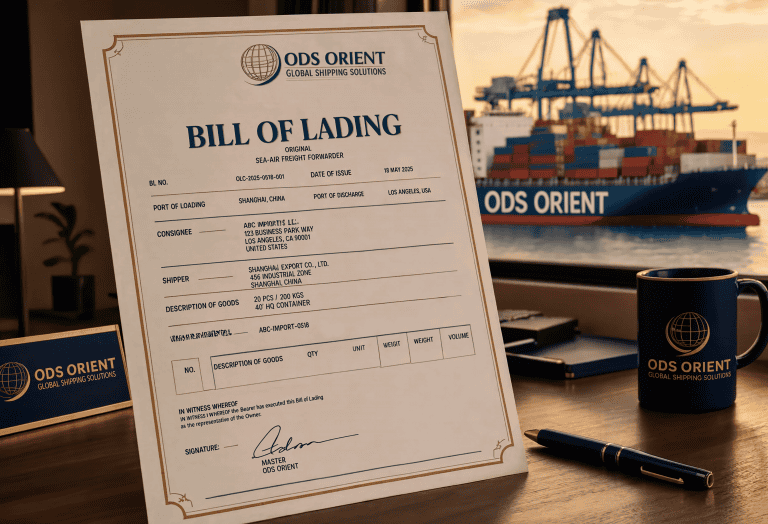
- The original bill of lading is the most important document required for the release of your vehicle.
- A local customs agent handles the customs declaration in the country of destination.
- Import duties consist of customs duties, taxes and local charges.
- Storage charges at the port will start to accrue after a short grace period.
- Missing or incorrect documents are the most common cause of delays.
What happens once your vehicle arrives at the port of destination?
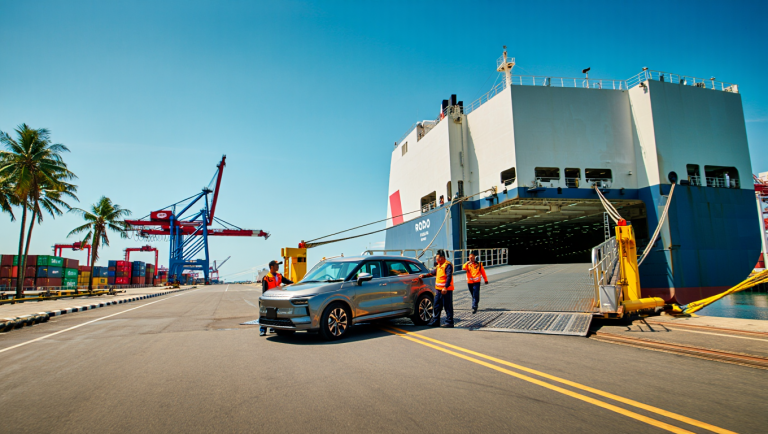
As soon as the Ro-Ro vessel reaches its destination port, your vehicle will be unloaded and taken to the port area. From that point onwards, it will be subject to the customs control of the country of destination. You may only collect or transport the vehicle once it has been fully cleared by customs.
The import process begins when the shipping company or your freight forwarder notifies you that the vehicle has arrived. You will usually receive an ‘Arrival Notice’, which contains all the relevant details about the shipment.
Arrival notification: The shipping company will inform you of the ship’s arrival.
Discharge: The vehicle is driven to the port terminal.
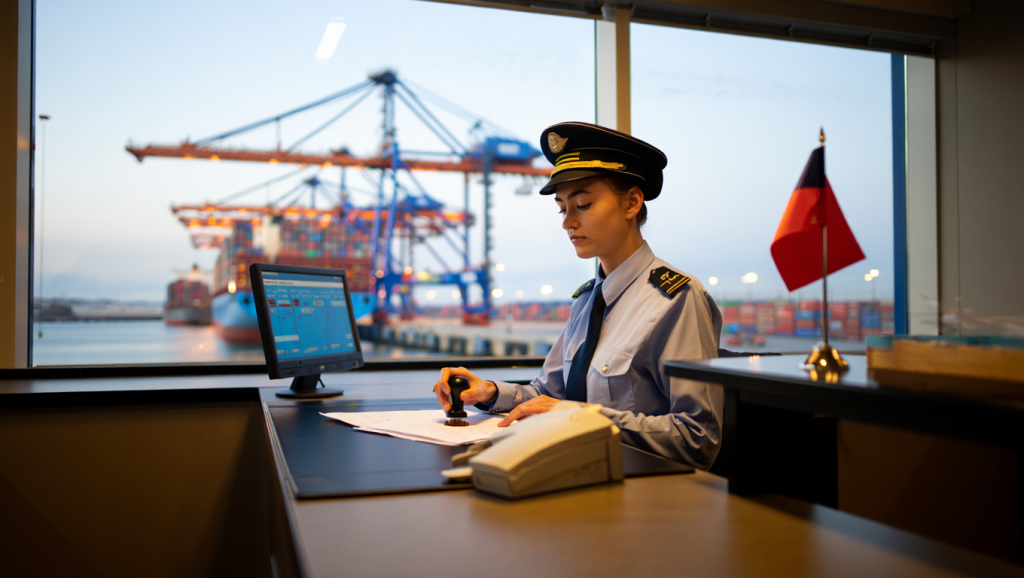
Customs inspection: The vehicle remains under customs seal until it is released.
Document verification: Your customs agent submits the import documents to customs.
Release: Once all charges have been paid, the vehicle will be released for collection.
What documents do you need for import customs clearance?
Document requirements vary depending on the destination country, but certain documents are required almost everywhere. Missing documents are the most common reason for delays in customs clearance.
| Document | Purpose | Hint |
| Bill of Lading (original) | Proof of the contract of carriage and title to the goods | No approval without the original |
| Commercial invoice | Proof of value for customs valuation | Must match the export declaration |
| Vehicle registration / Title | Proof of ownership of the vehicle | A copy or the original, depending on the country |
| Packing list | Description of the cargo | Particularly when it comes to additional parts in the vehicle |
| Import licence | Import licence | Not required in all countries |
| Certificate of Conformity | Technical standards | Country-specific – check beforehand |
Recommendation: Before dispatch, draw up a checklist of all the documents required in the destination country. Your customs agent can advise you on the country-specific requirements.
Why is a local clearing agent essential?
A customs agent (also known as a customs broker) is your local representative at the port of destination. They are familiar with local customs regulations, current duty rates and the procedures at the relevant terminal. Without a customs agent, customs clearance is practically impossible in most countries.
- He submits all the necessary documents to customs.
- He calculates the import duties due and arranges for payment.
- He liaises with the port authorities regarding any queries or inspections.
- He coordinates the collection of the vehicle once it has been released.
- He is familiar with local customs and can avoid delays.
ODS Orient works with experienced customs agents at all major ports of destination. On request, we can organise the entire import process for you.
What do import duties consist of?
The total cost of importation comprises several components. The exact rates and calculation methods vary considerably from country to country.
- Import duty – calculated on the basis of the vehicle’s customs value (CIF value).
- Import VAT – levied in many countries in addition to customs duties.
- Excise duty or luxury tax – applicable to certain categories of vehicles in some countries.
- Port charges – unloading and terminal charges levied by the port.
- Clearing fees – the customs broker’s fee for customs clearance.
The customs value (CIF value) generally comprises the value of the goods plus freight costs plus insurance. Most customs authorities calculate import duties on this basis.
What storage charges might be incurred at the port of destination?
Once your vehicle has arrived at the port of destination, a period known as ‘free time’ (or the demurrage-free period) begins. You can collect the vehicle within this period without incurring any additional storage charges. Once the free time has expired, storage charges will apply – and these can quickly add up to a significant amount.
Deadline: Typically five to fourteen days after arrival – depending on the port and shipping company.
Standard storage: Once the grace period has expired, daily storage charges will apply.
Long-term storage: After several weeks, the fees often rise progressively.
Additional costs: A charge may apply for moving the vehicle within the terminal.
Tip: Start preparing the import documents before the ship arrives. This will allow you to complete customs clearance within the grace period and avoid storage charges.
What are the common issues encountered during import customs clearance?
Even with careful planning, problems can arise during import customs clearance. The most common pitfalls can be avoided with the right preparation.
Document discrepancies: The values stated on the commercial invoice and the bill of lading do not match.
Missing import licence: In some countries, an import licence must be obtained before shipment.
Technical inspection: Customs has ordered a physical inspection of the vehicle.
Late payment: Bank transfers for import duties are taking longer than expected.
Quarantine requirements: Some countries require vehicles to undergo a bio-cleaning process.
Age restriction: Some destination countries prohibit the import of vehicles over a certain age.
Many exporters are particularly surprised by the age restrictions. You should therefore find out about the specific import regulations of your destination country well in advance.
How do you choose the right clearing agent?
The choice of customs agent has a direct impact on the duration and cost of customs clearance. A good agent saves you time and money – a bad one causes delays and unnecessary storage charges.
- Experience with vehicle imports – not every customs agent specialises in motor vehicles.
- Licensing and official approval from the local customs authorities.
- A transparent fee structure with no hidden charges.
- Accessibility and communication – ideally in a common language.
- References and recommendations from other importers or freight forwarders.
ODS Orient can arrange for certified clearing agents at your port of destination on request. This allows you to benefit from our many years of experience and a reliable network.
FAQ - Frequently asked questions
How long does customs clearance take at the port of destination?
If all the necessary documents are in order, customs clearance usually takes between three and seven working days. In countries with more complex procedures, or where an inspection has been ordered, it can take up to two weeks.
Can I get an estimate of the import duties in advance?
Yes, your customs agent can calculate the estimated import duties before dispatch. Please note that duty rates are subject to change and the final calculation will be made at the port of destination.
What happens if my bill of lading is lost?
The goods cannot be released without the original bill of lading. The shipping company can issue a replacement document, but this involves costs and the provision of a security deposit, and significantly delays the process.
Do I have to be present in person at the port of destination?
No, the clearing agent acts on your behalf. All you need is the relevant power of attorney and to submit the documents in good time.
What is a post-quarantine clean, and when do I need one?
Some countries, such as Australia and New Zealand, require vehicles to undergo a biological decontamination process prior to import. This involves removing soil, plant matter and insects. The importer is responsible for the costs.
Can I start using the vehicle straight away at the port of destination?
Not usually. Once customs clearance has been granted, the vehicle must be registered in the destination country. This often requires a technical inspection and compliance with local regulations.
Conclusion
Customs clearance at the port of destination is the final major step before you can take delivery of your vehicle. With the right documents, a competent customs agent and timely preparation, this process will run smoothly.
ODS Orient not only assists you with shipping, but also with import clearance at the port of destination. Our network of experienced customs agents ensures that your vehicle clears customs quickly and cost-effectively.
Do you have any questions or would you like a non-binding offer? Contact us directly: https://odsorient.com/kontakt
All information in this article has been carefully researched but is subject to change at any time. ODS Orient accepts no liability for the topicality, accuracy and completeness of the information provided.