Due to the current political situation, the following harbours are temporarily closed: Jebel Ali, Abu Dhabi, Sohar, Bahrain, Kuwait & Dammam!
RoRo vs. container 2026: Which method suits your cargo?
May 19, 2026
Reading time: 6 minutes
The difference between RoRo and containers lies primarily in the loading process: With RoRo, vehicles and rollable goods are driven on board independently, whereas container shipping transports cargo in steel boxes. RoRo is ideal for vehicles and machinery, containers are more suitable for general cargo and personal effects. Costs, transit times and availability vary considerably depending on the route and cargo type.
Short answer in 5 bullet points
RoRo is ideal for rolling cargo such as cars, lorries, construction machinery and boats on trailers.
Container shipping offers maximum protection and is ideal for general cargo, household goods or sensitive freight.
RoRo is usually cheaper for individual vehicles, while containers can be more economical for combined shipments.
Route availability is crucial: RoRo services serve fewer ports than container lines.
Hybrid approaches such as flat-rack containers combine the advantages of both methods for oversized cargo.
What is the fundamental difference between RoRo and containers?
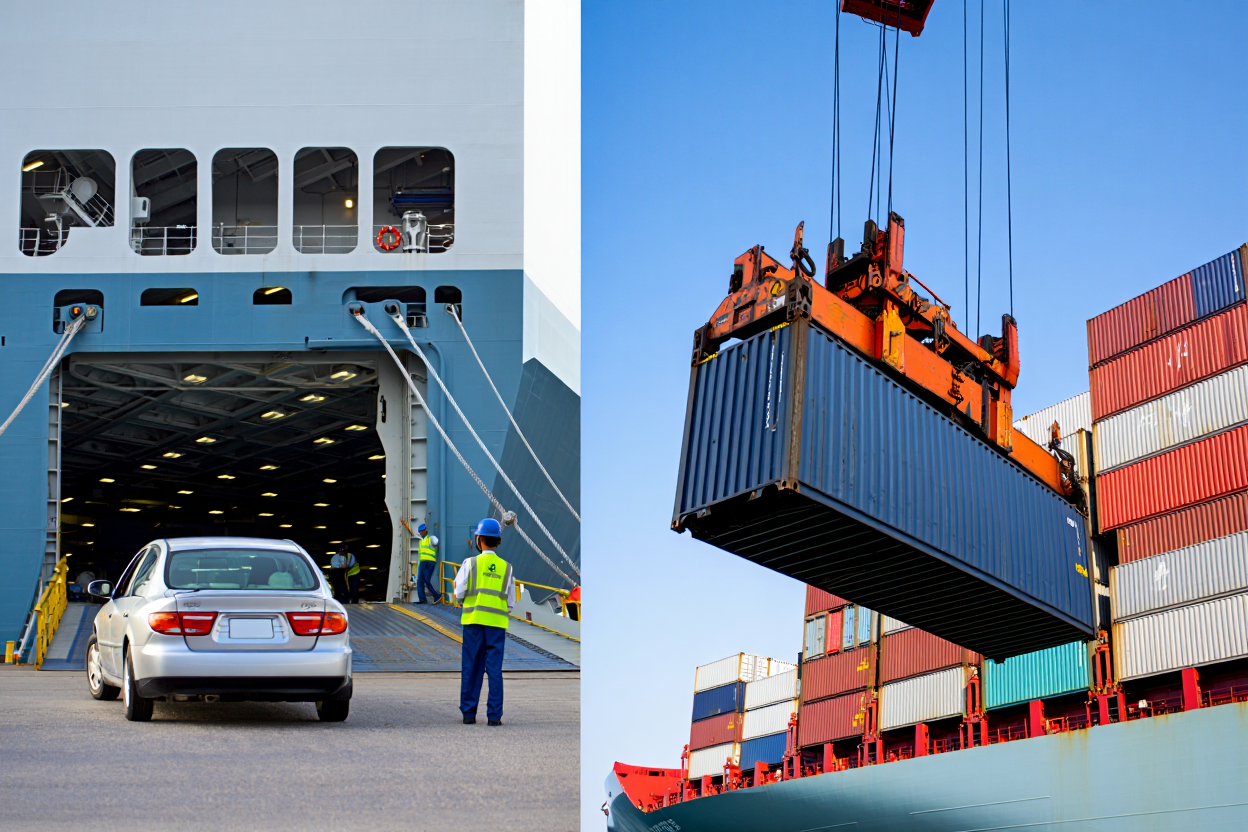
RoRo stands for roll-on/roll-off and describes a loading process in which vehicles and rollable goods are driven directly onto the ship via a ramp. The process is particularly efficient because no crane is required.
With container shipping, the cargo is loaded into standardised steel containers (20-foot or 40-foot) and lifted onto the ship by crane. This approach offers maximum weather protection and is suitable for almost any type of cargo.
Both methods have clear strengths: RoRo scores with speed and simplicity for wheeled cargo, while containers offer more flexibility and protection. The choice ultimately depends on your cargo, your budget and the desired route.
Which charge types are suitable for which method?
Not every cargo is suitable for every shipping method. The following overview will help you make the right decision for your specific situation.
Charge type
RoRo suitable?
Container suitable?
Recommendation
CAR / SUV
Yes - ideal
Possible (in container)
RoRo preferred
Lorry / Transporter
Yes - ideal
Only for small models
RoRo preferred
Construction machinery
Yes - on trailer
Only with flat rack
RoRo or flat rack
Household goods
No
Yes - ideal
Container
Motorbikes
Conditional (with pallet)
Yes - in the container
Container preferred
Boat on trailer
Yes - on trailer
Only very small boats
RoRo preferred
Mixed load
No
Yes - flexible
Container
Basically, if your load has wheels or fits on a trailer, RoRo is almost always the more efficient choice. For everything else, the container offers more security and flexibility.
How do the costs of RoRo and containers differ?
The cost structure of both methods differs fundamentally. With RoRo, you generally pay according to volume (cubic metres) or a flat rate per vehicle. With containers, the price is based on container size and weight.
For a single vehicle, RoRo is often the cheaper option as there is no container hire and no loading/unloading by crane. However, if you want to combine several items - such as a vehicle plus personal goods - a container may be more economical.
Cost factor
RoRo
Container
Base freight
By volume/flat rate
By container size
Loading/unloading
Low (self-propelled)
Higher (crane required)
Container hire
Failed
Additional costs
Insurance
Recommended
Recommended
Harbour dues
Standard
Standard
Combined load
Not possible
Possible and often cheaper
Always get quotes for both options before you decide. The actual costs vary greatly depending on the route, season and provider.
What transit times can be expected for RoRo and containers?
Transit times depend primarily on the route and not on the shipping method. However, there are indirect differences: RoRo ships often travel direct routes between large vehicle ports, while container ships can make more intermediate stops.
Typical transit times from European ports:
Middle East (e.g. Jebel Ali): 14-20 days by RoRo, 18-25 days by container
West Africa (e.g. Lagos): 16-22 days per RoRo, 20-28 days per container
South Africa (e.g. Durban): 18-24 days by RoRo, 22-30 days by container
North America (e.g. New York): 12-16 days by RoRo, 14-20 days by container
Please note that the loading and collection times in the harbour also vary. RoRo loading is usually faster, as no crane needs to be coordinated.
What about the safety of both methods?
Both shipping methods are fundamentally safe, but differ in the level of protection. In a container, your cargo is completely protected from the weather and external influences. With RoRo, your vehicle is on the lower deck of the ship - protected from the weather, but theoretically accessible.
Safety measures for RoRo:
Vehicles are professionally secured in the lower deck (lashing straps, wedges)
No access for passengers during the crossing
No personal belongings allowed in the vehicle (max. 1/4 tank)
Professional port security during loading and unloading
Safety measures for containers:
Sealed container with individual seal number
Complete protection against weather, salt water and theft
Additional load securing possible in the container
GPS tracking available with many shipping companies
When maximum protection is a priority - for example with classic cars or luxury vehicles - the container is the safer choice. For standard vehicles, RoRo offers an excellent level of security.
When does a hybrid approach make sense?
You don't always have to choose between RoRo and container. For oversized or particularly heavy loads, there are hybrid solutions such as flat-rack containers or open-top containers.
Flat rack container: Ideal for construction machinery, large vehicles or oversized loads that do not fit into a standard container.
Open-top container: Suitable for particularly high loads that have to be loaded from above.
Combined booking: Vehicle by RoRo, personal goods separately in the container - saves costs with maximum flexibility.
Break bulk: For very heavy individual items such as industrial plants that cannot be transported in containers or by RoRo.
Talk to your freight forwarder about hybrid options if your cargo does not clearly fall into one category. Creative combinations can often save considerable costs.
What decision criteria should you apply?
The choice between RoRo and container can be made systematically on the basis of a few key questions:
Does your load have wheels? If so, RoRo is the best choice in most cases.
Do you need maximum weather protection? Then a closed container is the safe option.
Would you like to combine several goods? Containers offer the necessary flexibility here.
Is your load oversized? Check flat rack or hybrid solutions.
What route are you planning? Check the RoRo availability for your port of destination.
Use this checklist as a starting point and then seek individual advice. Every shipment has its own special features, and an experienced freight forwarder can recommend the best solution for you.
What role does route availability play?
An often underestimated factor in the decision is route availability. Container ships serve significantly more ports worldwide than RoRo carriers. If your destination port is not served by RoRo ships, the only option is containerisation - or transhipment at an intermediate port.
Large RoRo ports such as Bremerhaven, Zeebruegge, Southampton or Emden offer regular departures to the most important destinations. For more exotic destinations, you may have to switch to containers or accept longer transit times.
Before booking, ask for the available departure dates and routes for both options. Sometimes a RoRo departure date a few days later makes more sense than an immediately available container - or vice versa.
FAQ - Frequently asked questions
Is RoRo cheaper than containers?
RoRo is generally cheaper for individual vehicles, as there is no container hire and no crane loading. However, a container can be more economical for combined shipments with several goods.
Can I transport personal belongings in a RoRo vehicle?
No, no personal belongings may remain in the vehicle during RoRo shipping. The tank must be reduced to a maximum of one quarter. Personal goods must be shipped separately in the container.
Which method is safer?
Both methods are fundamentally safe. However, containers offer fully enclosed and sealed protection, making them the preferred choice for luxury vehicles or sensitive cargo.
How long does shipping by RoRo take compared to a container?
RoRo is often slightly faster, as the ships take more direct routes and loading takes less time. The difference is typically two to five days, depending on the route.
Can I ship an unroadworthy vehicle by RoRo?
Yes, vehicles that are not roadworthy can be loaded onto a trailer or pallet and shipped by RoRo. However, this incurs additional costs for the trailer and loading.
Are there any size restrictions with RoRo?
RoRo can transport very large vehicles and machines as long as they can be rolled or fit on a trailer. The maximum dimensions depend on the respective ship and the ramp capacity.
When should I choose a flat-rack container?
A flat-rack container is the best choice for oversized or overwidth cargo that does not fit into a standard container, but also cannot be transported by RoRo - for example, large construction machinery that is not self-propelled.
Conclusion
The decision between RoRo and containers depends on your cargo, your budget and your route. For wheeled goods such as vehicles, lorries and construction machinery, RoRo is almost always the most efficient and cost-effective solution. For general cargo, combined shipments or destinations without a RoRo connection, the container is the right choice.
Use the decision matrix in this article as a guide and then seek individual advice. It is often only when you receive a concrete offer that it becomes clear which method is best suited to your specific shipment.
Do you have any questions or would you like a non-binding offer? Contact us directly: https://odsorient.com/kontakt
All information in this article has been carefully researched but is subject to change at any time. ODS Orient accepts no liability for the topicality, accuracy and completeness of the information provided.
Do you have any questions or would you like to make use of our RoRo service?
It is possible to ship a car to Indonesia by RoRo via the ports of Jakarta (Tanjung Priok) and Surabaya (Tanjung Perak). The transit time from Europe is around 28 to 35 days. Indonesia requires SNI certification, levies a luxury tax on certain vehicles and has strict import regulations. Careful preparation is therefore essential. A brief summary in 5 bullet points […]
Once your vehicle has arrived at the port of destination, customs clearance begins in the country of destination. For this, you will need the original bill of lading, a commercial invoice, the vehicle registration document and other country-specific documents. A local clearing agent will handle the process on site. Storage fees will apply if customs clearance is delayed. Quick answer in 5 bullet points What happens after your vehicle arrives at the port of destination? […]