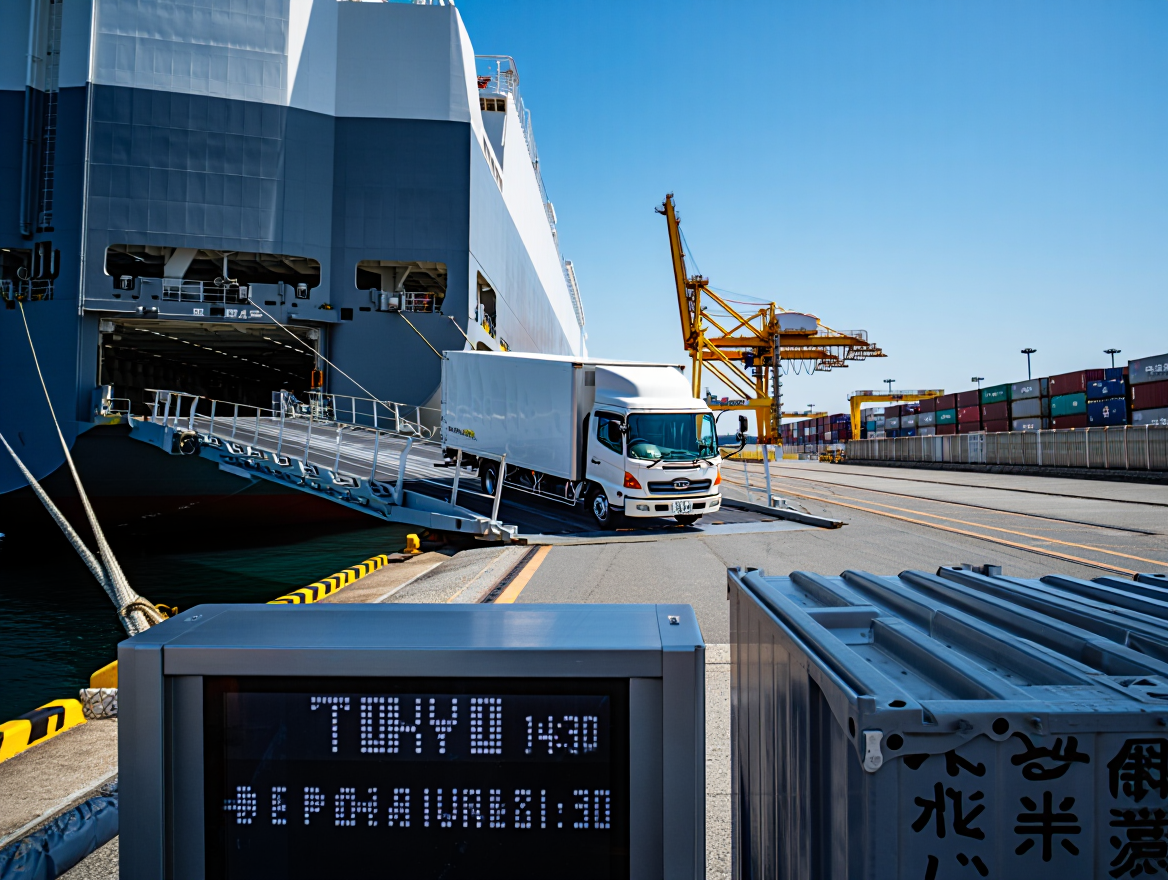
Whether you are a private customer or a company shipping japan planning, would like to know three things above all: What does it cost? Which routes make sense? What customs rules apply? This guide provides you with a compact but complete overview of cost factors, tried and tested sea routes (RoRo & container), Japanese import regulations and practical checklists. We also provide links to official sources and in-depth content from ODS Orient.
Why Japan? Opportunities & special features
Japan is one of the largest economies in the world and is strongly connected via seaports such as Yokohama/Tokyo Bay, Kobe/Osaka Bay and Nagoya. For vehicles and rolling machines RoRo (roll-on/roll-off) the preferred method; for general cargo, spare parts and palletised goods we offer Container (20′/40′/HC) Planning reliability and nationwide connections. The route- and season-dependent timetable is crucial - Timetables in real time help you to plan ETD/ETA realistically.
Cost factors: What Japan sea freight depends on
Concrete figures vary greatly - a personalised quote is required for individual costs. What drives the price in practice:
Relation & shipping company: Direct connections vs. feeder, demand, peak seasons (Golden Week, Obon, turn of the year)
Equipment & Method: RoRo (vehicles, rolling machines) vs. containers (FCL/LCL)
Dimensions & weight: OOG surcharges (oversize), heavy loads, special handling
Target-side levies: Taxes/duties on import (see section "Customs & taxes")
Tip: Start with Routing & Slots and work backwards to your cut-off. Use the timetables and insert buffers.
RoRo or container? The quick comparison
Criterion
RoRo (roll-on/roll-off)
Container (FCL/LCL)
Ideal for
Vehicles, rolling machines, trailers
Palletised goods, parts, sensitive goods
Handling
Vehicle drives/rolls on board
Craning, palletising/packaging if necessary
Cost structure
Shipping company/vehicle-specific tariffs, OOG surcharges if applicable
Freight + BAF/CAF + terminal costs, LCL surcharges if applicable
Transit planning
Liner services, but fewer ports/frequency than for containers
Very dense departures & global network
Risk/weather
Exposed, but manageable with sea defences/lashing
Protected in the container (with correct packaging)
Table description (alt text): Comparison of the most important differences between RoRo and container shipping to Japan.
More about the preparation: Checklist for RoRo shipping - Article: Customs documents for RoRo transport
Routes & transit times: Europe/USA → Japan (2025)
The actual transit time depends on ship rotation, harbour location, season, weather and stopovers. Use Live timetablesto check the current ETD/ETA.
Orientation overview (without guarantee)
Start region
Typical ports of departure
Destination ports Japan
Notes
Northern Europe
Bremerhaven, Zeebrugge, Southampton
Yokohama, Kobe, Nagoya
RoRo & Container; Feeder possible
Mediterranean Sea
Barcelona, Livorno, Piraeus
Yokohama, Kobe
Seasonal frequency fluctuations
East Coast USA
Baltimore, New York
Yokohama, Kobe
RoRo for vehicles widespread
Gulf/Middle East
Jebel Ali, Dammam
Yokohama, Kobe
Frequent transshipment
East Asia
Hong Kong, Busan, Kaohsiung
Yokohama, Kobe, Osaka
Dense container frequency
Table description (alt text): Overview of common departure and destination ports for the shipping japan (RoRo & Container) with information on frequencies/transshipments.
Customs & taxes in Japan (2025): What you need to know
Japan distinguishes between Customs (Import Duty)the Consumption tax and, if applicable, other charges on registration (e.g. vehicle-related taxes).
Consumption Tax: Standard 10 % on imports; calculation basis: customs value + customs duty/duties, if applicable → Source: Japan Customs - Outline of Tariff and Duty Rates System
[ ] Insurance completed & condition photos available
[ ] Questions? Contact ODS Orient
Conclusion
A successful shipping japan stands and falls with proper planning: Route selection, Realistic time frames, correct documents and the observance of the Japanese customs and tax rules. Knowing the differences between RoRo vs. container avoids unnecessary costs and delays.
For a concrete cost calculation you need a customised offer. Start with the Timetable check or have a look at our Customs documents for RoRo transport to.
Why 2026 will be a turning point From 1 January 2026, the International Maritime Organisation (IMO) will tighten its climate targets. The focus is on more binding efficiency paths for ships, stricter inspection obligations for shipping companies and concrete preparatory steps for global CO₂ pricing. For exporters, this means more transparency, more documentation - and potentially higher CO₂ cost components. Immediately helpful: Roadmaps → https://odsorient.com/fahrplaene What do I [...]
Why tracking with RoRo is more than just „ship on map“ RoRo (roll-on/roll-off) is a fast and robust shipping method for roadworthy vehicles. Nevertheless, many customers find the transport process opaque – especially when status information is scattered across emails, portals and PDF notifications. A structured RoRo tracking system brings order to this diversity of data and enables clear […]