
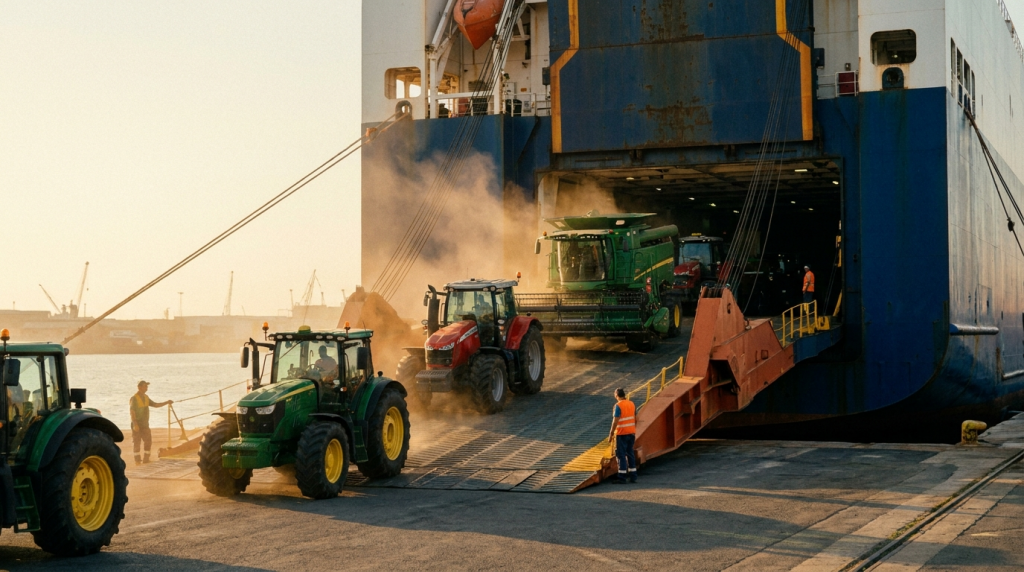
Short answer: Agricultural machinery such as tractors, combine harvesters and attachments can be shipped efficiently to Africa and Asia via RoRo. Roadworthy machinery rolls onto the vessel under its own power, whilst heavy, oversized or non-roadworthy units are loaded onto MAFI trailers. Crucial factors include proper load securing, complete export and import documentation, and coordination with customs authorities in the destination country.
The key points in 5 points
- RoRo is ideal for agricultural machinery that is capable of rolling or has been made capable of rolling.
- MAFI trailer enable the transport of heavy, oversized or non-roadworthy units.
- Load securing (Lashing) protects the machine from rough seas.
- Documents and customs are crucial to ensuring a smooth import process in the destination country.
- Dimensions and weight Specify these details precisely – they determine the loading method and planning.
Why is RoRo particularly suitable for agricultural machinery?
RoRo (Roll-on/Roll-off) is the obvious choice for self-propelled and wheeled machinery: the unit is driven on board via the ramp, without the need for a crane or complex handling operations. This reduces the risks associated with cargo handling and is widely available for many destination ports in Africa and Asia. We provide a general overview at Shipping agricultural machinery by RoRo.
How are heavy or non-roadworthy machines loaded?
Not every machine is ready to operate or suitable for direct access. This is where MAFI trailer (Roll-on trailer) is used: The machine is loaded onto the trailer, secured and rolled onto it using a tractor unit. This means that even oversized, over-height or damaged units can be transported safely. Check with your haulage contractor in advance whether your machine will be loaded in running order or requires a MAFI trailer.
What are the key considerations when securing a load?
Agricultural machinery often has a high centre of gravity and delicate attachments. To ensure safe transport, the following applies:
- Attachments Dismantle them where possible, or secure them separately.
- Moving parts Secure and lower (booms, buckets, cabs).
- Operating fluids reduce it to the permitted size, as specified by the shipping company.
- Lashing points Use it and secure the machine properly.
Careful documentation of the property’s condition, including photographs, prior to handover is your most important safeguard in this instance too.
What documents and customs regulations need to be taken into account?
For exports from Germany, the electronic export declaration must be submitted via the The customs authorities’ ATLAS procedure is required. In addition, a commercial invoice, a packing list and – depending on the destination country – specific import documents or certificates are required. Import regulations vary considerably, particularly in Africa and Asia; some countries require pre-shipment inspections or proof of conformity. Make sure you clarify the requirements of the destination country well in advance.
What are the typical goals – and what needs to be borne in mind?
Key target regions include West and East Africa, as well as South and South-East Asia. The choice of route and port of call depends on availability and the destination. We illustrate what a specific market looks like using the example of the Shipping to West Africa. Please bear in mind that the onward logistics from the port of destination within the country will need to be organised.
FAQ
Can I ship a non-roadworthy agricultural machine by Ro-Ro?
Yes. Machinery that is not roadworthy or is oversized is loaded onto MAFI trailers and rolled on board. Please clarify your requirements with your haulage contractor in advance.
Do I need to remove any attachments?
Often, yes – this reduces dimensions, weight and the risk of damage. Parts that cannot be dismantled must be securely fastened.
How are the costs determined?
The key factors are dimensions, weight, method of loading (road-ready or MAFI), as well as the route and port of destination. To obtain a reliable quote, you will receive a personalised offer based on this information.
What documents do I need for import?
In addition to the export declaration, a commercial invoice, a packing list and the country-specific import documents are required. Some destination countries require additional certificates or pre-shipment inspections.
Is it worth taking out transport insurance?
Yes. For high-value machinery, transport insurance is strongly recommended, as the shipping company’s liability is limited.
All the information in this article has been carefully researched, but is subject to change at any time. ODS Orient accepts no liability for the timeliness, accuracy or completeness of the information provided. Please contact us directly for a no-obligation quote.