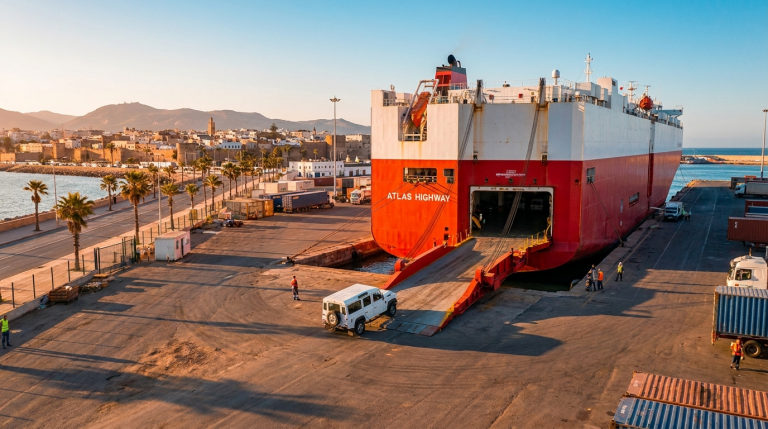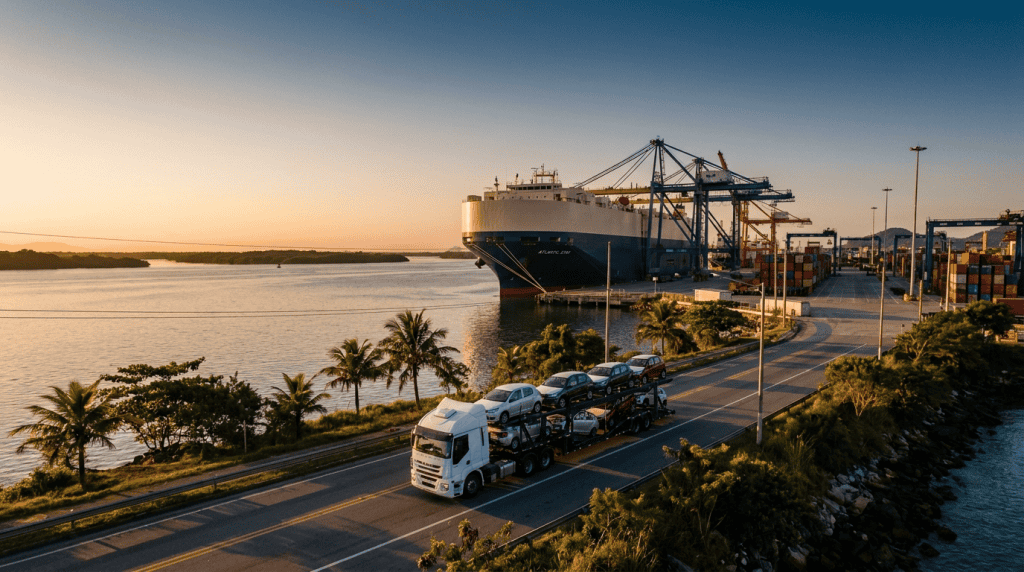
Short answer: The cheapest way to ship a car to Brazil is by RoRo via ports such as Santos or Paranaguá – transit from Germany takes around three to four weeks. However, customs are the key factor: Brazil largely prohibits the import of second-hand vehicles. Ro-Ro is a realistic option primarily for new cars imported via authorised importers, classic cars, diplomatic and removal goods, and machinery. Without a Brazilian customs agent (despachante aduaneiro), importing a vehicle is practically impossible.
The key points in 5 points
- RoRo is the standard For vehicles being shipped to Brazil – roll-on/roll-off is usually cheaper and easier than shipping by container.
- Major ports: Santos, Paranaguá, Rio de Janeiro and Vitória accept vehicles.
- Transit time: From Germany (Bremerhaven/Hamburg), it takes around 3–4 weeks to reach the Brazilian coast.
- The import of second-hand cars is severely restricted – Imports are generally prohibited, with a few exceptions.
- You can’t do anything without a customs agent: A customs agent and access to the Siscomex customs system are mandatory.
How do I ship a car to Brazil?
The usual way is to RoRo shipping: Your vehicle will be driven under its own power onto a specialised car carrier at the port of loading, secured in place, and then driven off again at the port of destination. This is quicker and usually cheaper than shipping in a container. From Germany, most vehicles set off from Bremerhaven or Hamburg. Expect a Transit time of around three to four weeks. But before you start thinking about ports and prices, there’s the real hurdle: Brazilian customs.
Am I even allowed to import a car into Brazil?
The answer comes as a surprise to many: Brazil generally prohibits the import of second-hand vehicles. A standard second-hand car can therefore usually be not Simply import. RoRo transport to Brazil is particularly relevant in the following cases:
- New vehicles through authorised importers and dealers.
- Classic cars and collector’s cars, which are regarded as collector’s items.
- Household effects and diplomatic vehicles under special customs arrangements.
- Construction, agricultural and industrial machinery in commercial imports.
Important: Whether your specific vehicle is eligible for import depends on the individual case. Please check this before the booking with a Brazilian customs agent and the customs authorities.
Which ports in Brazil accept vehicles?
- Santos (São Paulo): the largest port in Latin America and the most important transhipment hub for the south-east.
- Paranaguá (Paraná): one of the country’s most important vehicle terminals.
- Rio de Janeiro & Vitória: key hubs for the east and south-east.
- Suape (Pernambuco): relevant to the north-east.
Which port of destination is the most sensible depends on Destination within the country from – you’ll agree this with your haulier.
How does customs work in Brazil?
- Federal Revenue Service: The Brazilian Customs and Tax Authority handles the import process.
- Siscomex: the electronic foreign trade system through which imports are declared; depending on the circumstances, a Import licence (LI).
- customs agent: The licensed customs agent submits the import declaration and oversees the process.
- Import duties: Imported vehicles are subject to several taxes. The tax burden is high – it is essential to get a quote from your service provider.
What documents do you need?
- Commercial Invoice or proof of purchase
- Bill of Lading (B/L)
- Vehicle documents (Certificate of registration, proof of export from the EU)
- Packing list and condition report with photographs
- Import/customs documents in Brazil (prepared by the customs agent)
What common mistakes should you avoid?
- Shipment without import inspection: If the vehicle is not allowed to be imported, it will be held up at the port.
- No customs agent in the destination country: Without a customs agent, you won’t be able to get the vehicle out of the port.
- Overly tight planning: Cut-off times and long transit times require a buffer.
- Incomplete documents: Even a single piece of missing information can hold up customs clearance.
How do you plan the transport step by step?
- Check import eligibility – with the customs agent and the Federal Revenue Service before you book.
- Set destination port & route – in keeping with its destination in Brazil.
- Compile documents – Invoice, vehicle documents, proof of export.
- Approach to the port of loading organise and meet the cut-off time.
- Book RoRo shipping and fine-tune the tracking.
- Imports into Brazil handle this through the customs agent.
Further reading: In our guide on how to Exploring South America by RoRo, we’ll take a regional look at Brazil. Our guide to Shipping to Colombia. You can find the official import regulations at the Federal Revenue Service.
FAQ
Can I ship a standard second-hand car to Brazil?
Generally speaking, no. Brazil generally prohibits the import of second-hand vehicles. Exceptions are made, amongst other things, for collector’s vehicles, household effects and diplomatic goods – these are always assessed on a case-by-case basis and must be clarified with customs in advance.
How long does it take for a shipment to reach Brazil?
From Germany, the sea journey alone by RoRo typically takes around three to four weeks, depending on the route and the season. On top of this, there is the lead time and customs clearance.
Which port is the right one for my vehicle?
That depends on the destination. Santos and Paranaguá cover the south-east, Rio de Janeiro and Vitória the east, and Suape the north-east.
Do I need a customs agent in Brazil?
Yes. A licensed customs agent submits the import declaration via the Siscomex system and oversees the clearance process.
Ro-Ro or container shipping to Brazil – which is better?
For roadworthy vehicles, RoRo is usually the simpler and cheaper option. A container is particularly worthwhile for non-roadworthy or particularly valuable vehicles.
Disclaimer: This article is for general information purposes only and is not a substitute for individual customs or legal advice. Import regulations are subject to change and depend on individual circumstances. For a definitive assessment, please contact our team and a licensed customs agent.